

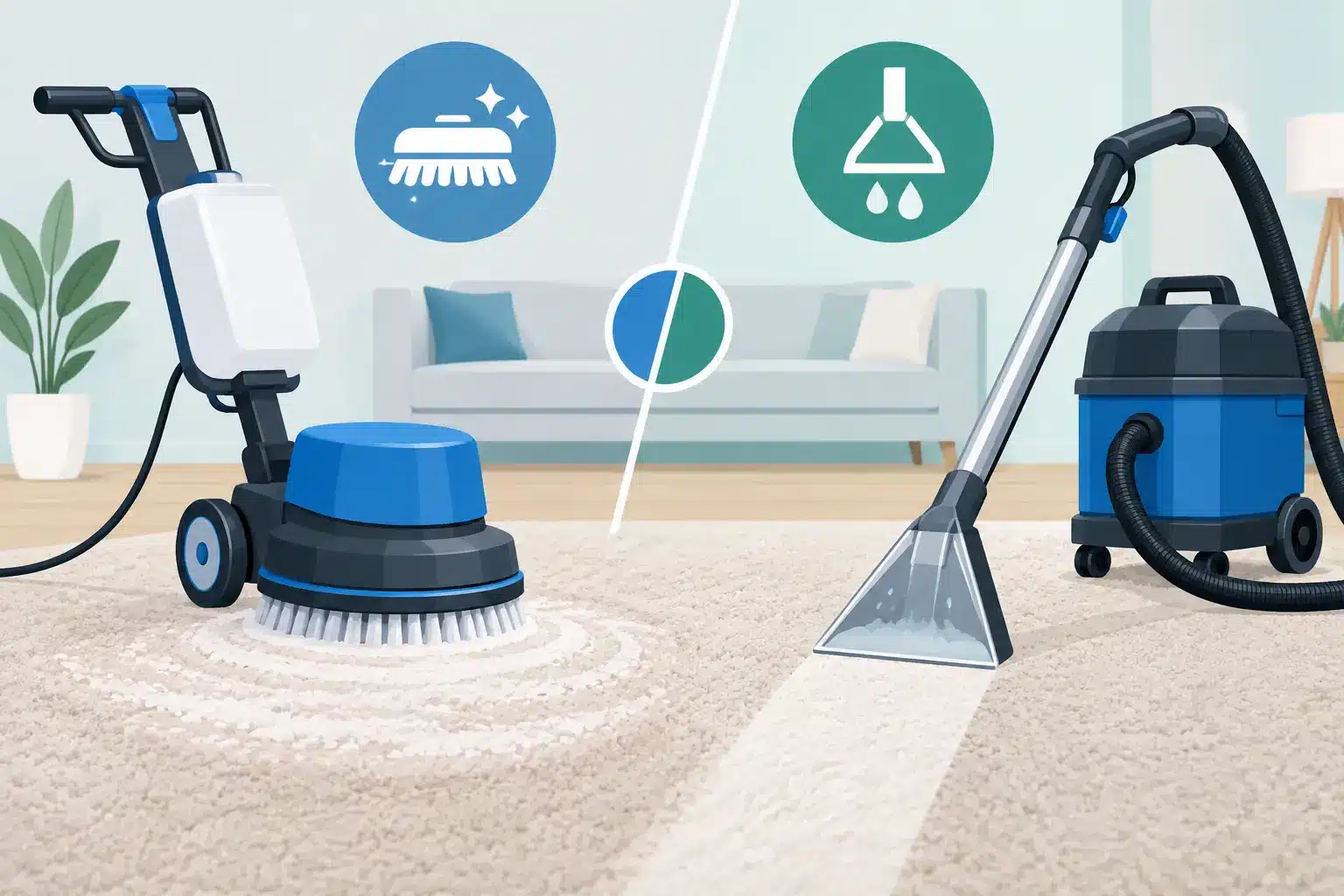
A coffee stain that keeps coming back after a few days, a lingering odor near the entryway, or a carpet that looks dull no matter how often you vacuum — these are rarely just surface problems. Between carpet shampooing and hot water extraction, the right choice depends mainly on how deeply soiled the carpet is, the type of fiber, and how much drying time you can afford in your home or business.
The word “shampoo” is often used as a catch-all for any kind of carpet cleaning. In reality, it can refer to very different methods. Some work mainly on the surface, while hot water extraction is designed to loosen and remove dirt buried deep in the fibers. Understanding this distinction helps you avoid either an insufficient treatment or a method poorly suited to a delicate rug.
Carpet Shampooing vs. Hot Water Extraction: The Real Difference
Traditional carpet shampooing involves applying a cleaning product often a foam or solution, then brushing the fibers to loosen dirt. Depending on the technique used, the residue is then vacuumed up or removed with a machine. This method can improve the appearance of a lightly soiled carpet and freshen up areas with light foot traffic.
Its main advantage is simplicity. It can work well for occasional maintenance, particularly when the carpet needs minimal moisture or very fast drying. However, if the contaminants sit deeper down, a shampoo treatment that leaves too much product in the fibers can attract more dust. The carpet may look clean at first, then get dirty again faster than expected.
Hot water extraction works differently. A cleaning solution, measured according to the material and stain type, is injected into the fibers under controlled pressure. Powerful suction immediately recovers the water, residue, and loosened particles. The goal isn’t just to mask a visible mark, it’s to remove as much embedded dirt as possible without oversaturating the backing.
When Is Carpet Shampooing the Right Choice?
Shampooing can be a valid option when it’s part of a regular maintenance routine and the carpet doesn’t have deep stains, strong odors, or sticky residue. It may also be the right pick for carpets whose fibers, dyes, or backing call for a low-moisture approach.
That said, the word “shampoo” alone doesn’t guarantee a safe method. Aggressive brushing can matte certain fibers, change the look of a velvet pile, or cause fuzzing. Too much product, or incomplete rinsing, can leave the surface rough and actually encourage faster re-soiling. Wool carpets, handmade rugs, oriental carpets, and glued-down materials all require an assessment beforehand.
A professional doesn’t choose a technique just because it’s popular or fast. They check the fiber type, colorfastness, condition of the backing, stained areas, and the risk of dye bleeding. This diagnostic step matters just as much as the equipment used.
The Limits of Rental Equipment
Machines rented from big-box stores can be fine for a light touch-up, but their suction power and moisture control are generally limited. The most common risk is wetting the carpet without being able to extract enough of the dirty water back out.
Extended drying time can cause odors, allow stains to migrate up from the backing, and leave a lingering feeling of dampness in the room. In basements, poorly ventilated homes, or humid stretches in Montreal, this is a particular concern. An improperly measured household product can also leave a soapy film that’s hard to remove during the next cleaning.
Why Hot Water Extraction Is Often the Deeper Clean
For a carpet that looks visibly grayish, stained, or holds onto odors, hot water extraction generally delivers a more thorough result. It targets contaminants trapped between the fibers — exactly where a vacuum or surface cleaner has little effect. Fine dust, allergens, pet hair, food residue, and oils tracked in by shoes can build up gradually without being visible at first glance.
That said, the quality of the process depends on execution. Excessive pressure, water that’s too hot, or an unsuitable solution can damage certain fibers. On the other hand, insufficient suction leaves residual moisture that slows drying. Professional carpet cleaning equipment allows technicians to adjust settings, pre-treat stains, and extract the cleaning solution efficiently.
Stains don’t all react the same way. A wine stain, a pet stain, grease, or ink each call for a different approach. Some older stains have already changed the color of the fiber and won’t fully disappear, even with the best treatment. A trustworthy company explains this limitation before starting the work, rather than promising an unrealistic outcome.
How Long Does Drying Take?
After a properly performed hot water extraction, a carpet should feel damp to the touch, but it shouldn’t be soaked. Drying time varies depending on carpet density, ambient humidity, ventilation, air circulation, and the quality of the extraction. Generally, you should plan for several hours — sometimes longer for a very thick carpet or a poorly ventilated room.
To speed up the process, it’s best to maintain good air circulation, use the building’s ventilation system when possible, and avoid putting heavy furniture back immediately. Furniture leg protectors also reduce the risk of color transfer or marks on a carpet that’s still damp.
How to Choose the Right Method for Your Situation
The decision isn’t just about budget or turnaround time. It has to account for the carpet’s actual condition and how it’s used. A rarely used guest room doesn’t have the same needs as a busy school hallway, a high-traffic office, or a living room shared with kids and pets.
Hot water extraction is often the right call when the carpet has localized stains, an odor, embedded dirt, or an overall loss of brightness. It’s also relevant after renovations, a move, a minor but well-contained spill, or a long stretch without a deep clean.
Low-moisture cleaning or targeted shampooing may be preferable for sensitive fibers, a rug that can’t be treated on-site, or a situation where drying time needs to be kept to a minimum. In some cases, a valuable rug is better served by specialized in-shop cleaning, with dusting, controlled washing, and drying suited to its construction.
Before any treatment, a colorfastness test and an inspection of fragile areas help protect your investment. The method should be chosen based on the material and the level of soiling — not a single solution applied to every carpet, regardless of type.
Preserving Results After Cleaning
A deep clean delivers better, longer-lasting results when paired with simple daily habits. Regular vacuuming removes abrasive particles before they get ground into the fibers. Well-maintained entry mats limit how much salt, sand, and moisture get tracked in — especially important during Quebec winters.
If a spill happens, blot it quickly with a clean white cloth rather than rubbing. Rubbing spreads the stain and can push the liquid deeper into the fibers. Also avoid mixing multiple household cleaning products — certain combinations can discolor the fiber or complicate a future professional treatment.
A planned, periodic maintenance schedule protects a carpet far better than a late intervention once stains have set in. For very active households and commercial spaces, cleaning frequency should be adjusted based on foot traffic, pets, allergy concerns, and carpet color.
The best choice between shampooing and hot water extraction is the one that respects your carpet while treating the dirt at its true level. A careful assessment before cleaning avoids unpleasant surprises and helps keep spaces cleaner, healthier, and more pleasant to use every day.
Is carpet shampooing the same as steam cleaning?
No. Shampooing applies a foam or solution that’s brushed in and then removed, while steam/hot water extraction injects a solution under pressure and immediately extracts it with powerful suction, reaching dirt deep in the fibers.
Which method is better for deep, embedded stains?
Hot water extraction is generally more effective for embedded dirt, since it’s designed to flush out contaminants trapped between fibers rather than just treating the surface.
How long does a carpet take to dry after hot water extraction?
It typically takes several hours, depending on carpet density, humidity, ventilation, and how well the water was extracted. Very thick carpets or poorly ventilated rooms may take longer.
Can shampooing damage a carpet?
It can, if done incorrectly. Aggressive brushing can matte fibers or cause fuzzing, and too much product or incomplete rinsing can leave a residue that attracts dirt faster.
Are rental carpet cleaning machines as effective as professional equipment?
Not usually. Rental machines tend to have weaker suction and less precise moisture control, which raises the risk of over-wetting and slow drying compared to professional-grade equipment.
Key Takeaways
- Carpet shampooing and hot water extraction are different methods — shampooing works mostly on the surface, while extraction is designed to remove dirt trapped deep in the fibers.
- Shampooing suits light, regular maintenance or fibers needing low moisture, but aggressive brushing or excess product can damage certain carpets and speed up re-soiling.
- Hot water extraction is generally best for visibly dirty, stained, or odorous carpets, but execution (pressure, water temperature, solution, suction) directly affects the outcome.
- Rental machines often lack the suction power and moisture control of professional equipment, increasing the risk of over-wetting and slow drying.
- Drying after extraction typically takes several hours and depends on carpet density, humidity, and ventilation — good airflow speeds it up.
- The right method depends on the carpet’s fiber, condition, and use case, not on budget or speed alone; a proper assessment (colorfastness test, fragile-area inspection) should come first.
- Regular vacuuming, entry mats, prompt blotting of spills, and avoiding mixed cleaning products all help preserve results between deep cleans.