

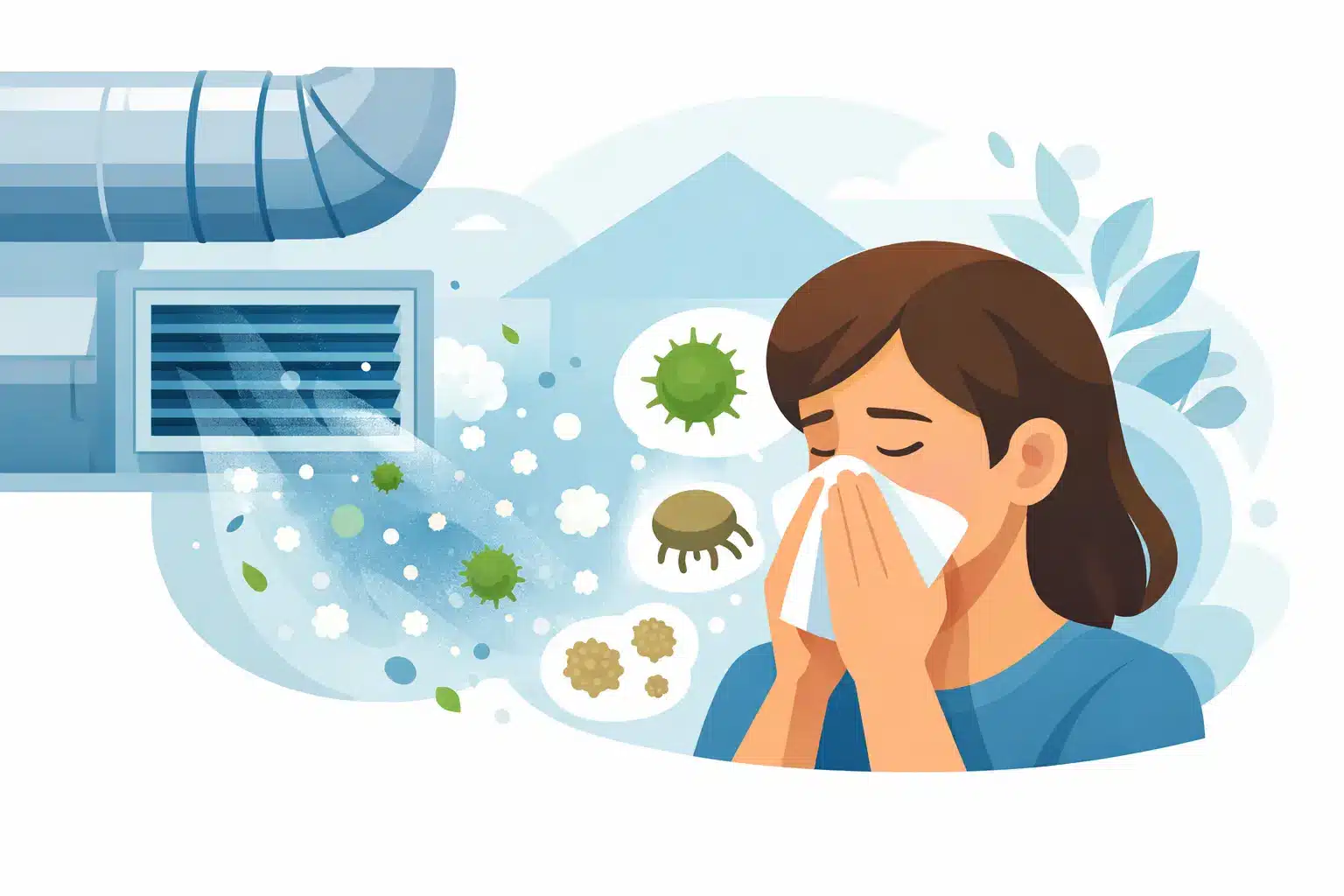
A child who sneezes mostly upon waking, congestion that lingers at home, or a dusty smell when the heat turns on all raise a fair question: do air ducts cause allergies? On their own, ventilation ducts do not create an allergy. However, when they accumulate and redistribute irritant or allergenic particles, they can worsen symptoms in sensitive people. In a home or commercial space, the ventilation system circulates the same air several times a day, so its cleanliness directly affects occupant comfort. Understanding what collects inside ducts, recognizing the relevant signs, and choosing the right time to act helps avoid unnecessary spending while protecting indoor air quality.
Do Air Ducts Cause Allergies or Just Make Them Worse?
The distinction matters. An allergy is an immune system reaction to a normally harmless substance, such as dust mites, pollen, pet dander, or certain moulds. Ducts do not generally produce these substances themselves. They can, however, become a reservoir for dust and debris, then recirculate it every time the furnace, air conditioner, air exchanger, or heat pump runs. In someone who already has allergies, this recirculation can intensify a runny nose, sneezing, congestion, itchy eyes, or coughing. People with asthma may also react more strongly to fine particles and airborne irritants. This does not mean every respiratory discomfort comes from the ducts; carpets, mattresses, upholstered furniture, excess humidity, pets, and ventilation habits can also play a role. The real question is not whether to automatically blame the ventilation network, but whether it is contributing to the overall particle load in the building.
What Can Build Up Inside a Ventilation System
A clean air duct is not necessarily sterile, and it does not need to be. The goal is to reduce abnormal buildup that interferes with airflow and can be resuspended into the air. In homes across Montreal, Laval, the North Shore, and the South Shore, seasonal changes, renovations, prolonged heating, and windows kept closed through winter all contribute to this buildup. Household dust is the most common element, containing textile fibres, skin cells, outdoor debris, pollen, and sometimes pet related residue. Dust mites live mainly in textiles such as mattresses, carpets, and armchairs, but their allergens can also travel with fine dust. Pet dander can linger in an environment long after an animal is gone. Pollen can enter through doors, windows, clothing, and shoes, then get pulled into air returns. In some cases, traces of mould can appear when moisture has infiltrated the system or when a condensation problem has gone uncorrected. Mould requires particular attention. Cleaning alone does not resolve an active moisture source; the cause, such as infiltration, inadequate drainage, poor insulation, condensation, or a poorly maintained appliance, must be identified before putting the system back into service. Otherwise, the problem is likely to return.
Signs That Justify a Professional Duct Inspection
Visible dust near the vents does not, on its own, prove the whole network is contaminated. It may simply mean the vent cover needs routine cleaning. Certain signs, combined together, do warrant a closer evaluation. A persistent odour of dust, mustiness, or moisture when the system starts up is worth noting, as is fine dust that reappears quickly on furniture shortly after cleaning, a home that recently underwent renovations, or a heating or cooling appliance that has been neglected for several years. Occupant symptoms can offer useful context, though they are not a medical diagnosis. If sneezing, eye irritation, or congestion increase indoors and ease elsewhere, it is worth examining the environment, though a medical consultation remains appropriate for symptoms that are persistent, significant, or accompanied by shortness of breath. In a rental building or commercial space, repeated complaints in one specific area can also point to a ventilation imbalance, an unsuitable filter, a blocked vent, or incomplete maintenance. A methodical inspection helps distinguish between these situations instead of treating every air quality issue the same way.
Why Cleaning Ducts Yourself Is Rarely Enough
Wiping dust off a vent cover or vacuuming just inside a duct opening is useful for regular upkeep, but it does not reach the full network, the bends, the air returns, or the sections connected to equipment. An improvised brush can even push dust further in rather than removing it. Professional duct cleaning aims to dislodge deposits and capture them using appropriate equipment, limiting their spread into living spaces. The method must be adapted to the type of system, the condition of the ducts, the materials involved, and the connected equipment. Flexible ducts, older systems, and mechanical components all require careful handling to avoid damage. Duct cleaning is not a promise to cure allergies; it is a maintenance measure that can reduce a source of accumulated contaminants, improve airflow, and support a healthier indoor environment. It matters most when there are concrete signs of buildup, after renovations, following a resolved water damage issue, or when system maintenance has been delayed.
A Complete Approach to Reducing Allergens at Home
The best results rarely come from a single intervention. If the ducts are clean but the filter is saturated or the carpets hold a large amount of dust, irritants will keep circulating through the space. Indoor air quality relies on several complementary actions. The system filter should be replaced according to manufacturer recommendations and usage conditions; a home with pets, children, recent renovations, or allergy sensitive occupants may need more frequent checks. A filter that is too clogged reduces airflow and can lower the system’s efficiency, while a filter that is too dense for the equipment can create excessive resistance. The right choice always depends on the equipment. Maintenance of air exchangers, wall mounted heat pumps, and dryer vents matters too; a poorly maintained heat pump can build up dust and moisture on its internal components, and a clogged dryer vent not only reduces drying efficiency but also increases risks linked to lint buildup. In bedrooms, regularly washing bedding and periodically cleaning mattresses, carpets, and upholstered furniture reduces the dust reservoirs where allergens can concentrate. Humidity control also matters, since excess humidity promotes mould and dust mites, while overly dry air can irritate the airways.
How Often Should Air Ducts Be Cleaned?
There is no single schedule that fits every building. Frequency depends on the age of the system, the number of occupants, the presence of pets, renovations, heating habits, filter quality, and any past moisture incidents. A home occupied by a family with pets that has undergone renovations does not have the same needs as a recently built, carefully maintained condo. Rather than relying on a rigid rule, it is better to schedule an evaluation once signs start to add up. A trustworthy provider should explain what they observe, describe the recommended work, and clarify what falls outside the scope of cleaning. This transparency protects the client from unnecessary interventions or exaggerated claims. Since 1995, Nettoyage Imperial has applied this technical approach to residential and commercial properties, assessing the actual condition of the system, using safe methods, and aiming for effective extraction of buildup, without presenting duct cleaning as a universal solution to every respiratory issue.
When Symptoms Persist Despite Regular Maintenance
If allergic reactions continue after a cleaning and a filter change, the search needs to widen. The source could be in the bedroom, in textiles, in a damp basement, a hidden leak, pets, or outdoor air. A doctor or allergist can also help identify personal triggers and build a suitable plan. A well maintained ventilation system does not replace medical follow up, but it removes one avoidable factor from the equation. For a home or workplace, it is a concrete way to gain more control over the air breathed every day.
Do dirty air ducts cause allergies?
Not directly. Ducts do not produce allergens themselves, but when they accumulate dust, pollen, pet dander, or mould traces, they can redistribute these particles through the home and worsen symptoms in people who are already sensitive.
What are the signs that air ducts need cleaning?
A persistent musty or dusty smell at startup, dust that reappears quickly after cleaning, a recent renovation, or a heating or cooling system that has not been serviced in years are all signs worth evaluating.
Can duct cleaning cure allergies?
No. Duct cleaning is a maintenance measure, not a medical treatment. It can reduce one source of accumulated contaminants and support better indoor air quality, but it will not eliminate an allergy on its own.
How often should ventilation ducts be cleaned?
There is no fixed schedule for every home. It depends on the age of the system, the number of occupants, pets, recent renovations, and filter quality, so it is best to schedule an evaluation when warning signs appear rather than following a rigid timeline.
What else helps reduce allergens at home besides duct cleaning?
Regular filter changes, humidity control, and cleaning textiles such as bedding, mattresses, carpets, and upholstered furniture all work alongside clean ducts to lower the overall allergen load in a home.
Key Takeaways
- Air ducts do not create allergies on their own, but they can accumulate and redistribute dust, pollen, pet dander, and mould, which can worsen symptoms in sensitive occupants.
- Common buildup inside ventilation ducts includes household dust, dust mites, pet dander, pollen, and, in some cases, mould linked to an unresolved moisture source.
- Warning signs worth watching include persistent musty odours at startup, dust reappearing quickly after cleaning, recent renovations, or years of neglected system maintenance.
- A DIY vent wipe down reaches only a small part of the system; professional duct cleaning is needed to reach bends, returns, and equipment connected sections.
- Indoor air quality depends on more than clean ducts alone: filter changes, humidity control, and regular textile cleaning all play a role, and persistent symptoms after maintenance warrant a medical consultation.