

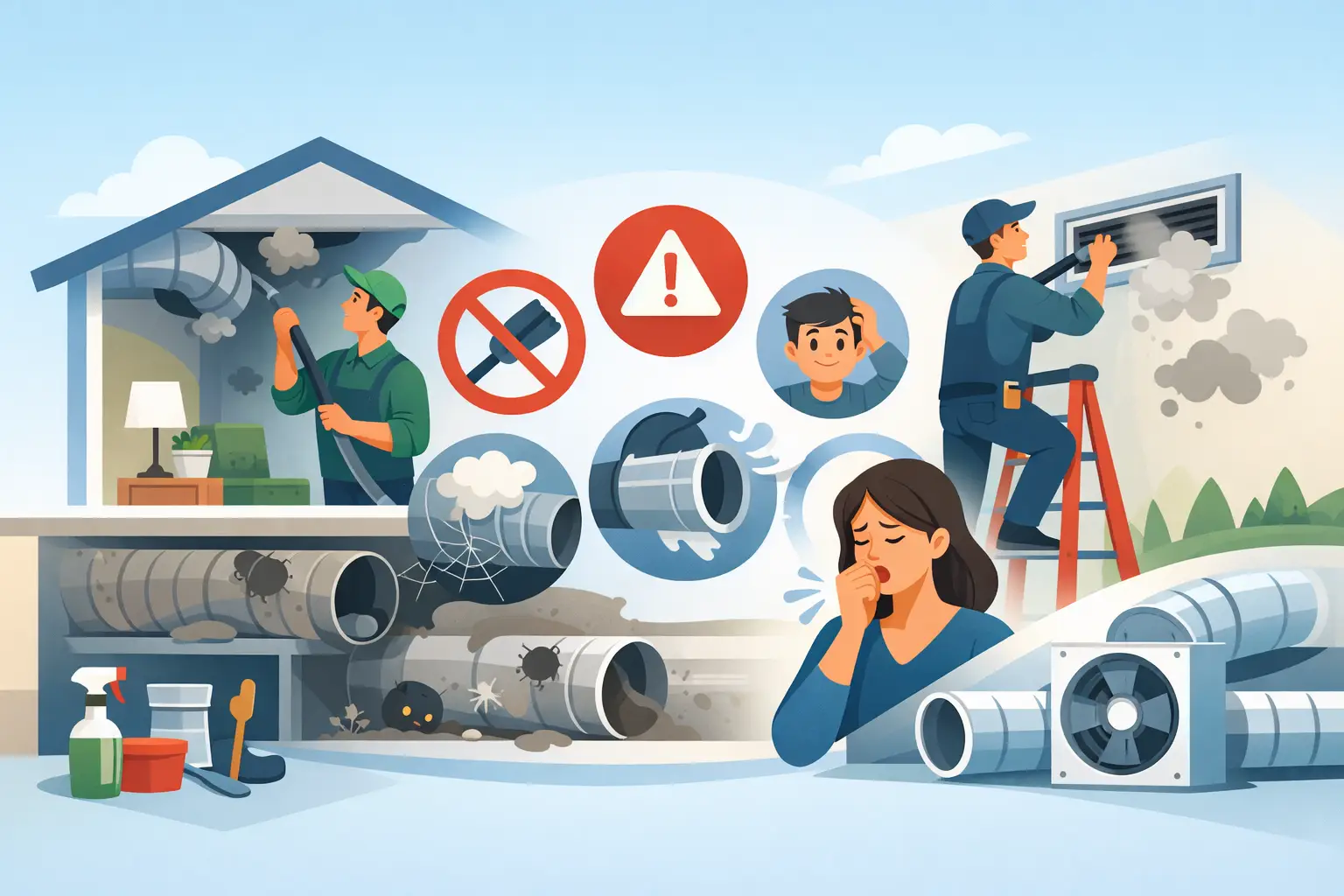
A duct may look spotless at the grille and still be harbouring fine dust, debris, and contaminants deep within your ventilation network. This is exactly where the most costly ventilation duct cleaning mistakes begin: trusting what you can see while the real problem hides in the sections you cannot.
Proper duct cleaning goes far beyond surface appearances. It affects indoor air quality, equipment efficiency, and in some cases, the safety of your home. Whether you are a homeowner, property manager, or renter in Montreal, Laval, the North Shore, or South Shore, you should never ignore the signs that ducts need cleaning because it make genuine difference.
Why Ventilation Duct Cleaning Mistakes Cost More Than You Think
When duct cleaning is done poorly, the consequences go well beyond a disappointing result. Dust gets displaced instead of removed. Flexible ducts can be damaged. Contaminated sections are left untouched. At first, you may notice more dust settling on surfaces, persistent odours, or uneven airflow. Over time, the wear on your ventilation system accelerates.
Your ventilation network functions as one connected system. Cleaning one vent while leaving the main duct, fan, or air exchanger components dirty means the benefit you paid for is only partial. Avoiding common duct cleaning errors requires a complete, methodical approach, not a surface-level touch-up.
The 7 Most Common Duct Cleaning Errors
1. Cleaning Only the Visible Grilles
This is the most widespread of all ventilation duct cleaning mistakes. Many homeowners remove grilles, vacuum the first few centimetres of accessible duct, and consider the job finished. In reality, the heaviest accumulation typically sits further into the network, where air constantly circulates. Cleaning only the outlets creates the illusion of a clean system without addressing the source.
2. Using the Wrong Tools
An improvised hose, an ill-fitting stiff brush, or an uncontrolled rotary attachment can damage ducts, especially older or flexible ones. A damaged duct loses its seal, retains more dust, and reduces system efficiency. What works on a metal trunk line is not necessarily appropriate for a flexible branch. This is one of the common duct cleaning errors that often goes unnoticed until a more serious problem develops.
3. Ignoring the Ventilation Unit Itself
Ducts are only one part of the system. If the fan, air exchanger, or internal compartments remain dirty, contaminants will quickly resettle throughout the network. A thorough service must account for the entire air circulation circuit. Treating the ducts alone is like washing half a window and calling it done.
4. Masking Odours Instead of Removing the Cause
When musty, dusty, or stale odours appear, some homeowners reach for a scented spray. However, these odours typically signal organic buildup, moisture imbalance, or prolonged lack of maintenance. A fragrance does not correct any of these issues. Worse, it can temporarily mask a problem that continues to worsen. This is among the signs ducts need cleaning, not a reason to delay service.
5. Accepting a Service That Is Too Fast to Be Thorough
A residential ventilation network cannot be cleaned properly in a matter of minutes. The time required depends on the size of the home, the number of vents, the type of equipment, and the degree of buildup. An unusually low price or a promise of extreme speed often signals a compromise on depth of work. In this trade, the method and the equipment matter as much as the cost.
6. Ignoring Clear Signs Ducts Need Cleaning
Visible buildup around grilles, more dust than usual after vacuuming, odours when the system starts up, or inconsistent airflow are all signs ducts need cleaning that should not be dismissed. Waiting too long allows buildup to worsen and can make the eventual service more involved. That said, not every system needs cleaning at the same frequency. A home with pets, recent renovations, or allergy-sensitive occupants has different needs than a lightly occupied, well-maintained property.
7. Confusing Routine Maintenance With Professional Duct Cleaning
Changing filters, dusting grilles, and monitoring humidity are all good habits. But they do not replace a technical cleaning of the duct network. Many homeowners maintain their systems diligently and genuinely believe they have already covered the essentials.
In reality, routine maintenance extends the results of a professional service. It does not replicate it. Both approaches are complementary, and understanding the difference helps you avoid ventilation duct cleaning mistakes rooted in good but misplaced intentions.
What a Proper Duct Cleaning Service Should Include
A serious service begins with a clear assessment of your installation. The technician should verify the condition of your ducts, the materials involved, any significant buildup, and access to different sections of the network. This step prevents standardised interventions that ignore the actual state of your system.
The method must focus on extracting contaminants, not simply moving them around. This requires appropriate equipment, controlled airflow, and procedures that protect the duct network during the process.
In many cases, cleaning related components such as parts of the air exchanger or ventilation unit is also necessary for a lasting result. A reliable service provider will also explain what was found, what was done, and what realistic maintenance steps to follow going forward.
How to Avoid a Poor Duct Cleaning Experience
Before agreeing to any service, ask straightforward questions. Which sections of the system will be treated? Does the service cover only the grilles or the entire accessible network? Is the method suited to the type of ducts in your home? A trustworthy technician answers with precision. Vague or evasive answers are a warning sign.
It is also worth confirming that the company uses a consistent method, trained technicians, and equipment designed for this work. In your home, you want neither improvisation nor unnecessary intervention.
You want a controlled, safe, and proportionate cleaning based on the real condition of your system. Companies like Nettoyage Imperial operate on exactly this principle: proper diagnosis, an adapted method, and durable results over quick fixes.
What are the most common ventilation duct cleaning mistakes homeowners make?
The most frequent errors include cleaning only the visible grilles, using inappropriate tools, ignoring the ventilation unit itself, and accepting rushed services. Each of these common duct cleaning errors results in incomplete cleaning that can lead to more dust, persistent odours, and accelerated wear on your ventilation system.
What are the clearest signs ducts need cleaning?
Watch for visible dust buildup around grilles, more surface dust than usual after cleaning, odours when the system activates, or noticeably uneven airflow between rooms. These are reliable signs ducts need cleaning and should not be ignored, particularly in homes with pets, recent renovations, or occupants with allergies.
Does using an air freshener solve duct odour problems?
No. Odours coming from your ventilation system typically indicate organic buildup, moisture issues, or contamination within the ducts. A scented product masks the symptom temporarily but does not address the underlying cause. A proper inspection is the only reliable solution.
How often should residential ducts be cleaned in Montreal or Laval?
There is no single universal answer. The right frequency depends on your home’s size, occupation level, whether pets are present, and how recently any renovations were completed. A professional assessment gives you a more accurate recommendation than any generic schedule.
How do I know if a duct cleaning service is thorough?
A credible provider will assess your full system before beginning, explain which components will be treated, use equipment suited to your duct type, and provide a clear summary of findings afterward. If a quote seems unusually low or the timeframe unusually short, those are signs the service may not be complete.
Key Takeaways
- The most expensive ventilation duct cleaning mistakes often come from cleaning only what is visible while leaving contaminated sections of the network untreated.
- Common duct cleaning errors such as using improper tools or ignoring the ventilation unit can damage your system and reduce its efficiency over time.
- Key signs ducts need cleaning include visible grille buildup, excess household dust, activation odours, and uneven airflow between rooms.
- Routine maintenance like filter changes does not replace professional ventilation duct cleaning of internal components and ductwork.
- A trustworthy service provider will assess your full system, explain the method used, and tailor the approach to your specific installation.
- Homeowners in Montreal, Laval, the North Shore, and South Shore should seek services that prioritise diagnosis and lasting results over speed and low pricing.