

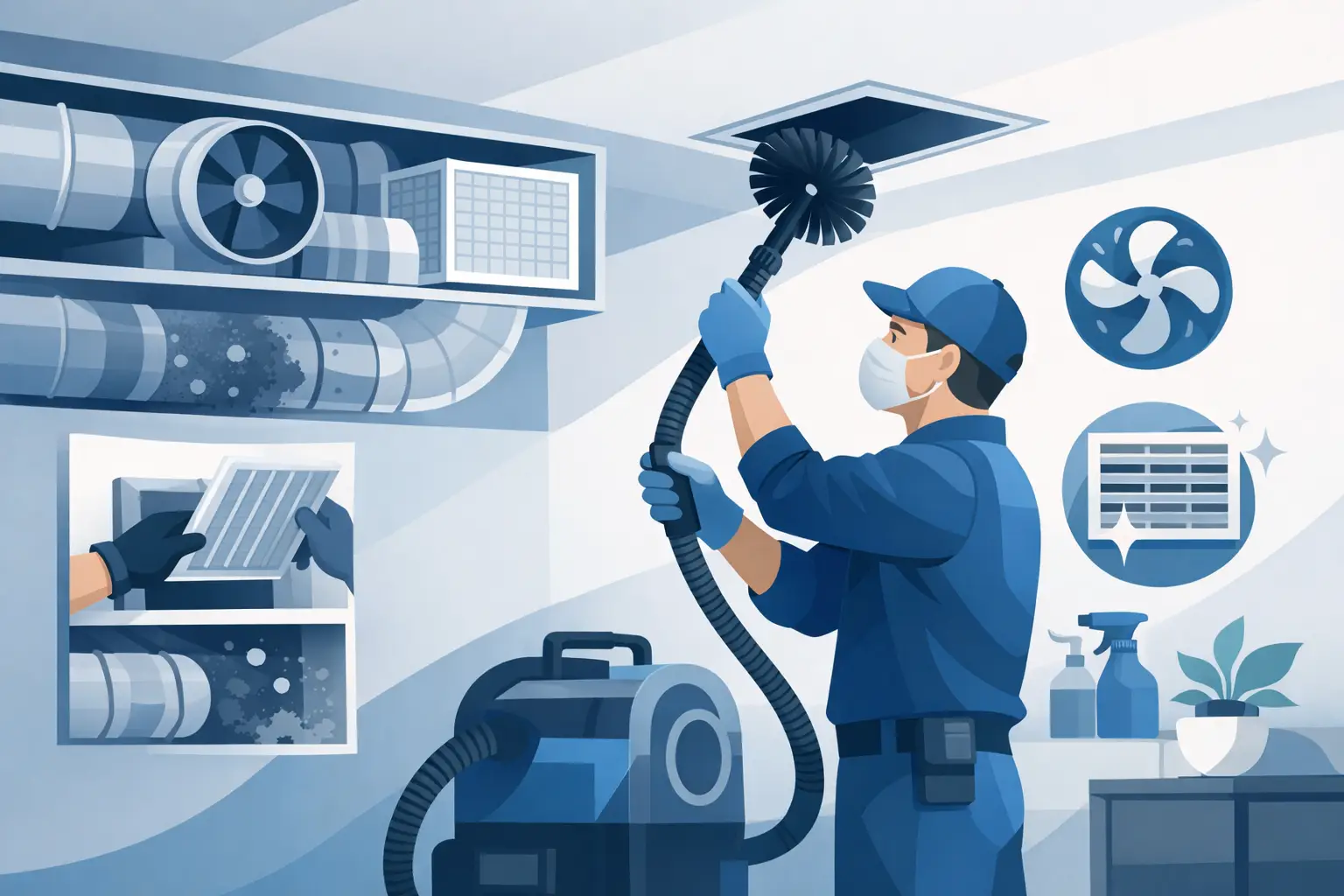
When a home feels dustier than usual, certain rooms won’t heat evenly, or a strange smell appears every time the system kicks on, the filter is rarely the whole story. More often, the issue comes down to residential ventilation duct maintenance and whether it’s being done correctly for your home’s specific setup. Understanding how to maintain home air ducts properly makes a measurable difference in comfort, air quality, and system performance.
Your ventilation network is not a minor technical detail. It affects how air moves through every room, how allergens behave indoors, and how efficiently your heating and cooling equipment operates. Done right, proper maintenance supports cleaner air and a more stable system. Done poorly, it can shift dust around without removing it, damage components, or create a false sense of cleanliness that doesn’t last.
Why Proper Residential Ventilation Duct Maintenance Actually Changes Results
Ducts accumulate a mix of fine dust, debris, pet hair, textile fibres, and sometimes residual moisture over time. In a busy household with children, pets, recent renovations, or heavy daily foot traffic, that buildup can happen faster than most homeowners expect.
The first concern is indoor air quality. When ducts are loaded with contaminants, particles can re-enter circulation with every system cycle. This does not automatically make every dirty duct dangerous, but it can worsen an already sensitive environment, particularly in homes where allergies, asthma, or persistent odours are already a concern.
The second concern is performance. A partially obstructed or neglected network rarely fails dramatically. Instead, you notice gradual signs: uneven airflow between rooms, less effective air return, a heavier feeling indoors, visible deposits near vents, or equipment that seems to work harder than it should. The real cost accumulates over time through premature wear and inconsistent output.
How Often Should You Schedule Residential Ventilation Duct Maintenance
There is no single frequency that works for every home. In a standard residence, professional residential ventilation duct maintenance is generally considered every few years, but the right interval depends heavily on your household’s specific circumstances.
A home with pets, young children, smokers, or recent drywall work will need more frequent attention. The same applies to rental properties where occupancy habits shift between tenants. On the other hand, a well-maintained home with consistent filter changes and minimal dust sources may sustain acceptable duct conditions for longer. Following solid duct cleaning best practices at home means watching for signals rather than counting years.
If your vents get dirty soon after cleaning, a musty odour appears when the system starts, or your air exchanger seems less effective, it is worth having the system evaluated rather than waiting for conditions to worsen.
Key Signs Your Home Air Ducts Need Attention
Some warning signs appear frequently across Montreal, Laval, North Shore, and South Shore homes. Dust resurfacing quickly after cleaning, visible deposits around supply or return air vents, musty odours, and uneven airflow from room to room are all reliable indicators that residential ventilation duct maintenance is overdue.
Context matters too. After renovations, a move, prolonged construction, or purchasing an older home, how to maintain home air ducts becomes immediately relevant even without obvious symptoms. Construction particles are fine, abundant, and rarely captured fully by a standard filter alone.
It is also worth distinguishing between your main duct network and related components such as dryer vents, air exchangers, and wall-mounted heat pump units. Each may have its own maintenance need, and a proper assessment avoids treating the entire system when only one area requires attention.
What Proper Duct Cleaning Best Practices at Home Actually Look Like
Following duct cleaning best practices at home does not mean running a household vacuum attachment near a vent and calling it done. A serious service starts with a clear read of the network: number of ducts, accessibility, installation type, contamination level, and the overall condition of all components.
From there, contaminant extraction requires equipment capable of creating sufficient negative pressure within the system so particles are captured rather than redistributed. Depending on the layout, targeted mechanical work may be needed to dislodge deposits in key duct sections. Vents, accessible components, and strategic points throughout the system all require methodical treatment.
The level of intervention must match the material, age, and objective. Routine upkeep, post-renovation restoration, and advanced odour or contamination treatment are not the same job. An overly aggressive clean can be counterproductive. An overly superficial one accomplishes almost nothing.
What Homeowners Can Do and When to Call a Professional
There are several useful steps any homeowner can take without risk. Replacing the system filter on the manufacturer’s schedule is the foundation of good residential ventilation duct maintenance. Dusting vent covers, monitoring airflow changes, and staying alert to unusual odours are also simple but valuable habits.
This is why many homeowners across Greater Montreal trust trained technicians for this work. A reputable provider does not simply run equipment through the ducts quickly. They evaluate the system, perform the work cleanly, protect all components, and aim for a measurable improvement in both hygiene and performance.
Nettoyage Imperial has provided exactly that standard of service to residential clients across Montreal, Laval, North Shore, and South Shore since 1995.
Residential ventilation duct maintenance is not about reacting to a crisis. It is about consistent, informed care that protects your home’s air quality, preserves your equipment, and keeps your living environment comfortable year-round. Knowing how to maintain home air ducts and applying proven duct cleaning best practices at home puts you well ahead of most homeowners who only act when the problem becomes impossible to ignore.
How often should residential ventilation duct maintenance be performed in a typical Montreal home?
Most homes benefit from professional residential ventilation duct maintenance every three to five years. Homes with pets, young children, smokers, or recent renovations in the Montreal, Laval, or Greater Montreal area may need attention more frequently. Monitoring your system for dust buildup, odours, and uneven airflow is the most reliable guide.
What are the most important duct cleaning best practices at home for everyday upkeep?
The most impactful duct cleaning best practices at home include replacing your filter on schedule, keeping vent covers dust-free, and noting any changes in airflow or odour. These habits reduce buildup between professional cleanings and help you catch problems before they affect system performance.
How do I know how to maintain home air ducts if I am not sure about my system type?
Understanding how to maintain home air ducts starts with identifying your setup, whether it includes an air exchanger, dryer vent, or heat pump. A qualified technician can assess your specific configuration and recommend a maintenance plan suited to your home rather than a generic schedule.
Can I clean my own ducts without professional equipment?
Surface cleaning around vents is a safe and useful habit. However, accessing the interior of the duct network, dislodging compacted deposits, or servicing mechanical components without proper equipment and training risks redistributing contaminants or damaging the system. Professional residential ventilation duct maintenance uses negative pressure equipment designed specifically for this work.
Does duct cleaning actually improve indoor air quality in homes with allergies?
In homes where allergens, dust, or mould-related particles have accumulated in the ductwork, professional cleaning can meaningfully support better indoor air quality. While it is not a cure for all allergy concerns, combining clean ducts with regular filter changes and good duct cleaning best practices at home reduces the overall particulate load circulating through your living spaces.
Key Takeaways
- Residential ventilation duct maintenance should be guided by your home’s specific conditions, not a fixed universal schedule.
- Learning how to maintain home air ducts starts with simple habits like regular filter changes and monitoring airflow and odour.
- Following duct cleaning best practices at home means distinguishing between what homeowners can safely do and when professional equipment is required.
- Gradual signs like uneven airflow, dusty vents, and musty odours are reliable indicators that your duct network needs professional attention.
- Post-renovation, post-move, and seasonal transitions are ideal moments to schedule residential ventilation duct maintenance.
- A professional service from a trusted provider like Nettoyage Imperial goes beyond surface cleaning to deliver measurable results in air quality and system performance.