

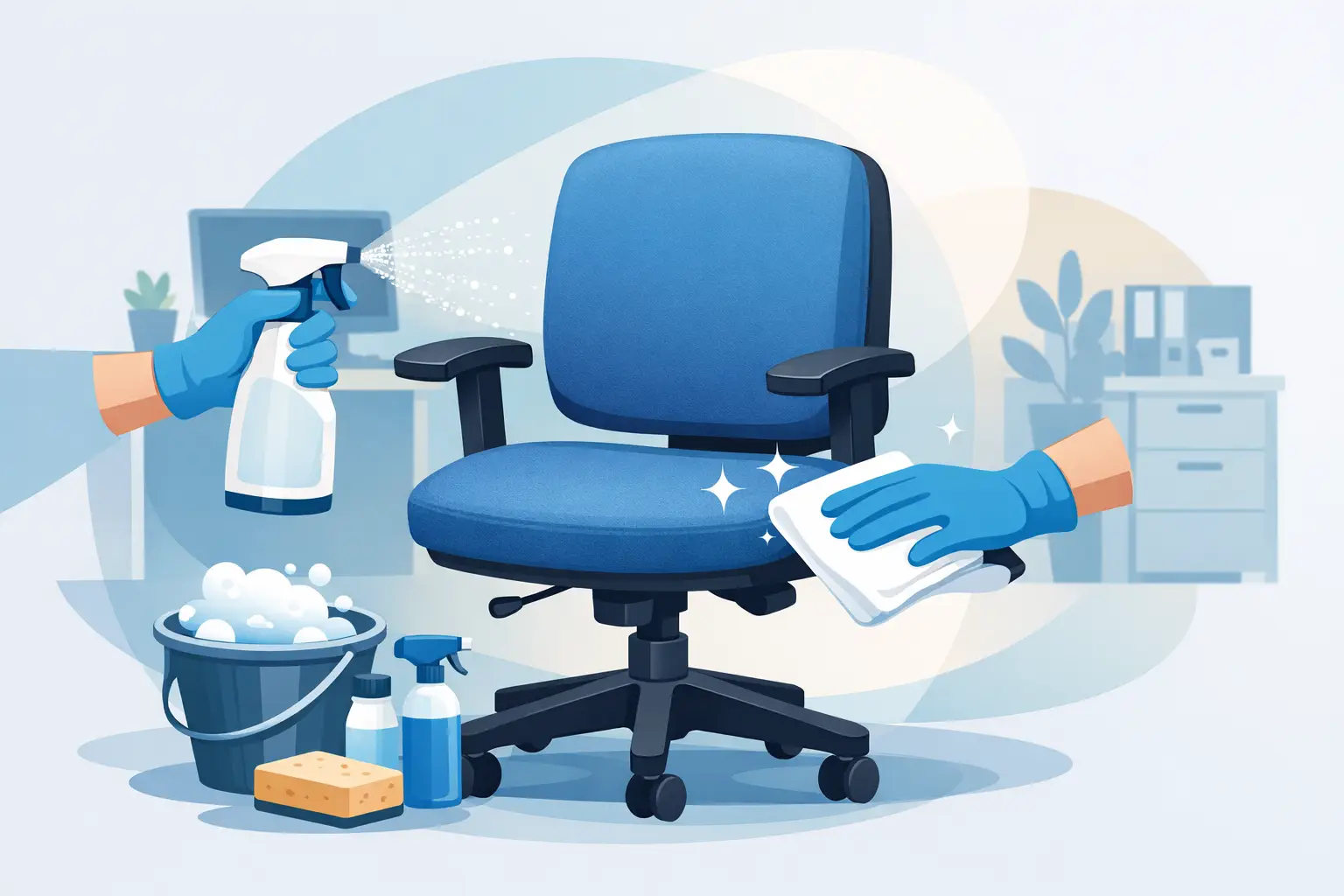
A fabric office chair rarely looks dirty all at once. It dulls gradually, holds onto odours, traps dust, and eventually the armrests and seat cushion start showing visible marks. That’s usually the moment people wonder how to clean a fabric office chair quickly, without risking damage to the foam or setting a stain that’s already there.
The concern goes beyond appearance. A chair used every day collects fine particles, skin oils, fabric residue, and the occasional food or drink spill. Whether it’s in a home office or a commercial workspace, that buildup affects how the chair looks, how hygienic it is, and how long the upholstery actually lasts. Done right, office chair upholstery cleaning restores a fresher look, reduces odours, and helps prevent premature wear.
Why Office Chair Upholstery Cleaning Requires a Careful Approach
Fabric office chair is not a flat textile surface. The fabric covers foam padding, seams, tension zones, and sometimes glued or moulded components. If too much water is used, moisture can seep into the cushioning and take a very long time to dry. The results are rarely good, watermarks, a lingering damp smell, or a seat that feels wet hours after cleaning.
While learning how to clean a fabric office chair, the type of fabric also matters. Some chairs are upholstered in durable synthetic textiles, while others have a more textured weave that responds poorly to friction. An approach that’s too aggressive can pill the surface or cause uneven fading, especially on areas that are already worn. That’s why an effective office chair upholstery cleaning technique is built on three principles: remove dry debris first, treat stains with the right product, and keep moisture firmly under control.
How to Clean a Fabric Office Chair: Step by Step Guide That Actually Works
Start With Thorough Vacuuming
The first step in office chair upholstery cleaning is always to vacuum the chair carefully. Cover the seat, backrest, seams, and every junction between the fabric and the frame. This step is often skipped, but it removes a significant amount of dust and abrasive particles. If you apply moisture before this dry extraction, you turn surface debris into a paste that works its way deeper into the fibres and makes everything harder to treat.
Treat Stains Before General Cleaning
Coffee rings, grease marks, sweat stains, and darkened contact zones all behave differently. Apply a small amount of the appropriate solution, then work gently with a clean cloth or soft brush. The goal is to lift the soil without spreading it. Scrubbing harder rarely helps and usually makes things worse by pushing the contaminant further into the upholstery.
Use a Low-Moisture General Cleaning Method
For overall office chair upholstery cleaning, a low-moisture approach works best. A lightly dampened cloth combined with a product designed for textile fibres is usually enough to refresh the whole surface. In more severe cases, controlled extraction may be needed, but it should be used sparingly. A chair is not a carpet, and its foam padding cannot handle excess water.
If you’re learning how to clean a fabric office chair, focusing on minimal moisture and gentle products is key to protecting both the fabric and the internal padding.
Drying time matters just as much as the cleaning itself. Good air circulation is essential. Avoid sitting back down too soon, since compressing a still-damp seat can push dirt back to the surface and create new marks.
Common Mistakes When Trying to Clean Mesh or Fabric Office Chair Without Damage
One of the most frequent mistakes while learning how to clean a fabric office chair is reaching for a multipurpose household cleaner. Many of these products leave behind a sticky residue that attracts dust quickly. Others contain agents too strong for upholstery fibres and cause subtle, sometimes permanent discolouration. When the goal is to clean a mesh office chair without damage, product selection is not a minor detail.
Another common error is soaking the fabric with soapy water. The surface may look clean right away, but hours later a watermark appears or an odour develops. This happens when dissolved soil migrates outward as the fabric dries, or when moisture sits trapped inside the foam. Rubbing too hard is also a problem. On set-in stains, the instinct is to apply more pressure, but that wears the fibre, changes the texture, and can actually bond the contaminant more firmly into the material.
Which Stains Come Out Easily and Which Need Professional Help
Fresh stains from light beverages or surface-level dirt generally respond well to prompt treatment. If you act before the stain fully dries, recovery is usually straightforward. Things get more complicated with grease, old marks, blackened contact zones, and embedded odours. In those cases, what’s visible on the surface is often just part of the problem. Some of the material has already penetrated the foam or bonded with the fibres.
While understanding how to clean fabric office chair, it’s also important to have realistic expectations. A heavily used chair, one exposed to direct sunlight or with mechanical wear, may still show some marks even after thorough cleaning. Professional office chair upholstery cleaning removes buildup and sanitises the textile without promising a return to brand-new condition. Honest assessment is part of what makes a serious cleaning service worth trusting.
When to Call a Professional Cleaning Service in Montreal
Knowing how to clean a fabric office chair at home goes a long way, but some situations call for a more thorough approach. Professional help makes sense when multiple chairs need treatment, when the fabric is delicate, or when stains keep coming back despite regular upkeep. Offices, meeting rooms, reception areas, and workstations in Montreal, Laval, the North Shore, and the South Shore are all environments where presentation and hygiene have a direct impact on the work environment.
An experienced technician starts by identifying the upholstery type, the level of soiling, and the safest cleaning method. That diagnostic step prevents the use of standardised treatments that aren’t suited to padded materials. The advantage of a professional service lies both in the outcome and in the process itself: matched products, controlled application, careful extraction, and significantly reduced drying time.
For both businesses and homeowners, professional office chair upholstery cleaning is also a way to extend the life of the furniture. Replacing several chairs costs considerably more than planned periodic maintenance. When the fabric is still structurally sound, professional treatment is almost always the more practical choice.
How Often Should You Schedule Fabric Office Chair Upholstery Cleaning
Frequency depends on use, and understanding how to clean a fabric office chair properly also includes knowing how often to do it. A chair used a few hours a week in a home office has very different needs than one occupied full-time in an open-plan workspace.
In practice, consistent light maintenance prevents deep buildup and keeps each cleaning session simpler. For residential use, regular vacuuming paired with a more thorough clean at longer intervals is usually enough. In shared professional environments, that schedule needs to be more frequent.
The right indicator is not only the presence of visible stains. A chair that looks dull, holds onto odours, or has fabric that feels rough is already signalling residue accumulation. Waiting until marks are clearly visible tends to make office chair upholstery cleaning significantly more involved.
How do I know which cleaning product is safe to use for office chair upholstery cleaning?
Check the manufacturer’s care label first. Look for a code: W means water-based cleaners are safe, S means solvent-based only, W/S means both are acceptable, and X means vacuuming only. When in doubt, test any product on a hidden area before applying it to visible surfaces. Avoid multipurpose household cleaners, as many leave residue or cause fading on upholstery textiles.
Can I use a steam cleaner to clean a fabric office chair without damage?
Steam can be effective on certain fabrics, but it must be used with care. Too much heat or moisture can damage foam padding or cause shrinkage in some textile weaves. If you’re not certain of the fabric type, a low-moisture cloth method is safer. For stubborn stains or full chair refreshing, professional office chair upholstery cleaning is a more reliable option.
How long does a fabric office chair take to dry after cleaning?
Drying time varies based on how much moisture was used and how well the space is ventilated. When considering how to clean a fabric office chair, using a low-moisture method allows a chair to be ready within a few hours. If more water was applied, plan for six to twelve hours. Using a fan or opening windows helps speed the process. Never sit on the chair until it is fully dry, as compression can push stains back to the surface.
Is professional cleaning worth it for a single office chair?
It depends on the condition of the chair and the type of staining. For deep-set stains, grease marks, or persistent odours, professional treatment is often more effective than repeated at-home attempts. In a professional setting in Montreal or the surrounding area, it also makes sense from a hygiene and presentation standpoint. For businesses managing multiple chairs, the cost per unit is typically very reasonable.
How do I maintain my fabric office chair between professional cleanings?
Vacuum regularly to prevent abrasive dust from building up in the fibres. Address spills immediately by blotting with a clean, dry cloth, never rubbing. Avoid placing the chair in direct sunlight for extended periods, and keep food and beverages away when possible. These habits reduce the frequency and intensity of cleaning needed over time.
Key Takeaways
- Learning how to clean a fabric office chair properly starts with dry extraction before any moisture is introduced
- Office chair upholstery cleaning requires matched products, the wrong cleaner can cause discolouration or leave sticky residue
- To clean a mesh office chair without damage, always use gentle pressure and work in small sections
- Recent stains respond well to quick action; older or grease-based stains may need professional treatment
- Moisture control is critical, over-wetting leads to watermarks, slow drying, and foam damage
- Regular light maintenance prevents deep buildup and keeps professional cleaning simpler and less frequent