

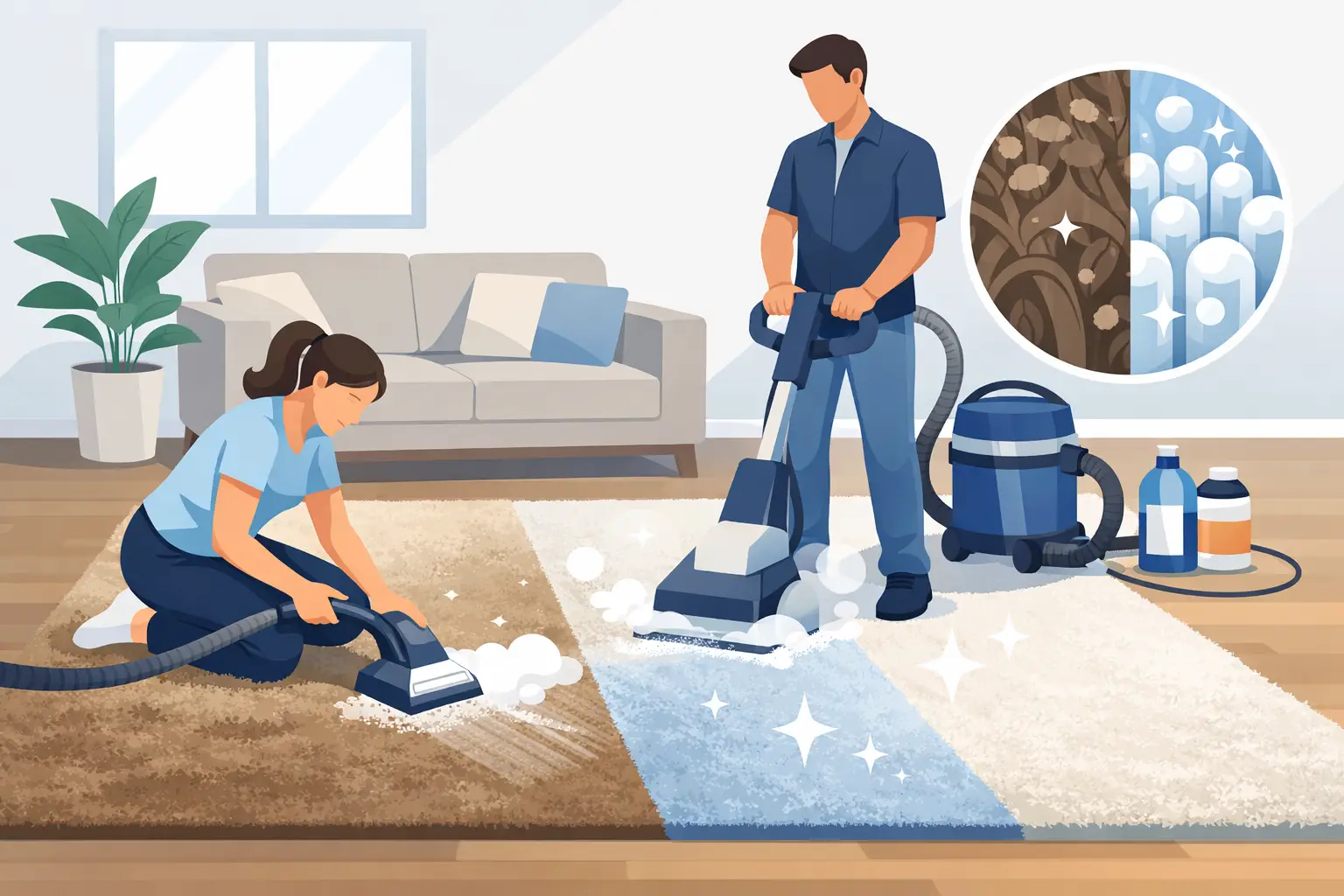
A carpet can look perfectly fine on the surface and still be hiding fine dust, allergens, greasy residue, and odours deep in its fibres. That is the real challenge of deep carpet cleaning at home: the goal is not just to refresh the appearance, it is to remove what has built up beneath the surface without damaging the material. For homeowners in Montreal, Laval, the North Shore, and the South Shore, understanding how to deep clean carpet without machine makes all the difference.
What You Can Realistically Achieve at Home
With the right technique, deep carpet cleaning at home can meaningfully improve hygiene, reduce mild odours, and lift a significant portion of embedded dirt. That said, it is important to stay realistic. Even a well-executed home cleaning rarely matches the extraction power, moisture control, or diagnostic precision of professional equipment.
This is especially true for heavily soiled carpets, old stains, natural fibre rugs, or carpets that have already been cleaned incorrectly multiple times. Pushing too hard in these situations can set stains permanently, cause ring marks, or leave too much moisture trapped at the base of the carpet.
Start With a Proper Diagnosis
Before applying anything to your carpet, identify the fibre type. Synthetic fibres like polyester, olefin, and most nylons generally tolerate moisture and mild cleaning products well. Wool, sisal, jute, and many handcrafted rugs require far more caution. These are essential home carpet deep cleaning tips that are often overlooked until damage is already done.
Observe three things closely: the condition of the colours, the pile thickness, and the nature of the soiling. Dry soil tracked in from outside is not treated the same way as a coffee spill, and pet odour requires a completely different approach than general traffic grime. Always test an inconspicuous area first. If colour transfers onto a damp white cloth, if the fibre distorts, or if the border weakens, stop immediately and reconsider your method.
The Safest Method for Deep Cleaning Your Carpet at Home
The first step is always mechanical. A slow, thorough vacuum pass in multiple directions removes a surprising amount of dry particles before any moisture is introduced. This phase is consistently underestimated. Skipping it properly means you are turning loose dust into mud the moment water touches the carpet. This is one of the most practical home carpet deep cleaning tips you can apply right away.
Spot treatment comes next. Always blot, never scrub. Aggressive rubbing spreads the soiling and prematurely wears down the fibres. For most recent household stains, a gentle textile-safe solution applied with a clean cloth is enough to lift the mark gradually without creating a halo effect.
For general cleaning, the key is going deep while controlling how much water you apply. This is exactly what makes how to deep clean carpet without machine errors so important to understand: an over-diluted or poorly rinsed carpet shampoo attracts new dirt after drying. Low-residue formulas are preferable. If you are using a home injection-extraction machine, work in small sections and make multiple dry passes to recover as much moisture as possible.
The Most Common Mistakes to Avoid While Deep Carpet Cleaning at Home
The biggest problem with most home cleanings is excess water. Many people assume a very dirty carpet needs heavy soaking. In reality, over-saturation increases the risk of stain migration, fibre distortion, and lasting odours. Knowing how to deep clean carpet without machine flooding is one of the most valuable things you can learn.
Over-applying product is equally problematic. A heavily foaming carpet is not a more thoroughly cleaned carpet. Sticky residue left in the fibres picks up dust rapidly, making the carpet appear to re-soil within days. Home carpet deep cleaning tips like vinegar or baking soda can help in specific cases but are not universal solutions. On natural fibres or high-value rugs, the wrong concentration can cause more harm than good.
When to Call a Professional Instead of Deep Carpet Cleaning at Home
Some situations genuinely call for professional intervention: unknown old stains, embedded odours, high-value rugs, water damage, delicate fibres, or repeated unsatisfying results at home. This is not a question of convenience but of material safety and outcome quality. Deep carpet cleaning at home has real limits, and knowing where those limits are protects your investment.
A qualified professional brings three things that are rarely achieved simultaneously at home: the right diagnosis, the right cleaning chemistry, and the right level of extraction. This is what allows for a genuinely deep clean without over-wetting the carpet or weakening its fibres. Since 1995, Nettoyage Imperial has served homeowners across Montreal, Laval, the North Shore, and the South Shore with exactly this technical approach, with close attention to material safety, indoor air quality, and the long-term condition of every carpet treated.
Is deep carpet cleaning at home effective for removing allergens?
Deep carpet cleaning at home can reduce allergens significantly when done correctly. Regular vacuuming with a HEPA filter followed by proper low-moisture cleaning removes a large portion of dust mites and fine particles. However, households with severe allergies or heavily loaded carpets may still benefit from professional extraction for a more thorough result.
How to deep clean carpet without machine damage or over-wetting?
When learning how to deep clean carpet without machine over-saturation, the key is minimal moisture and maximum dry extraction. Apply cleaning solution sparingly, blot rather than scrub, and use multiple dry vacuum passes after treatment. Always allow full drying time with good airflow before walking on or replacing furniture.
What are the best home carpet deep cleaning tips for pet odours?
The most important of all home carpet deep cleaning tips for pet odours is to treat the source, not the symptom. Surface cleaning or fabric sprays only mask the issue temporarily. The odour is often embedded in the backing or subfloor. Enzyme-based treatments help break down organic residue, but persistent or widespread pet contamination usually requires professional-grade extraction.
How often should deep carpet cleaning at home be done?
For busy households with children, pets, or high foot traffic, deep carpet cleaning at home every three to six months is reasonable. In lower-traffic rooms, once or twice a year may be sufficient if regular vacuuming is consistent. Allergy sufferers may benefit from more frequent cleaning to prevent the carpet from becoming a reservoir for fine particles.
Can deep carpet cleaning at home damage wool or handmade rugs?
Yes. Wool and handcrafted rugs are among the most sensitive materials and should be approached with extreme caution. Many of the standard home carpet deep cleaning tips that apply to synthetic carpets do not translate to natural fibres. Wool can felt, discolour, or lose its texture when exposed to strong alkalines, high heat, or aggressive scrubbing. For valuable or delicate pieces, professional assessment is strongly recommended.
Key Takeaways
- Deep carpet cleaning at home requires identifying fibre type before selecting any cleaning method.
- Always vacuum thoroughly before introducing moisture to avoid turning dry soil into embedded mud.
- Knowing how to deep clean carpet without machine over-wetting is essential: excess water causes stain migration, odours, and fibre damage.
- Among the most important home carpet deep cleaning tips is to blot stains, never scrub, and use low-residue cleaning formulas.
- Pet odours and old stains that return after drying signal a problem in the backing or subfloor, not just the surface.
- For high-value rugs, persistent odours, or unsatisfying results, professional cleaning protects your investment better than repeated home attempts.