

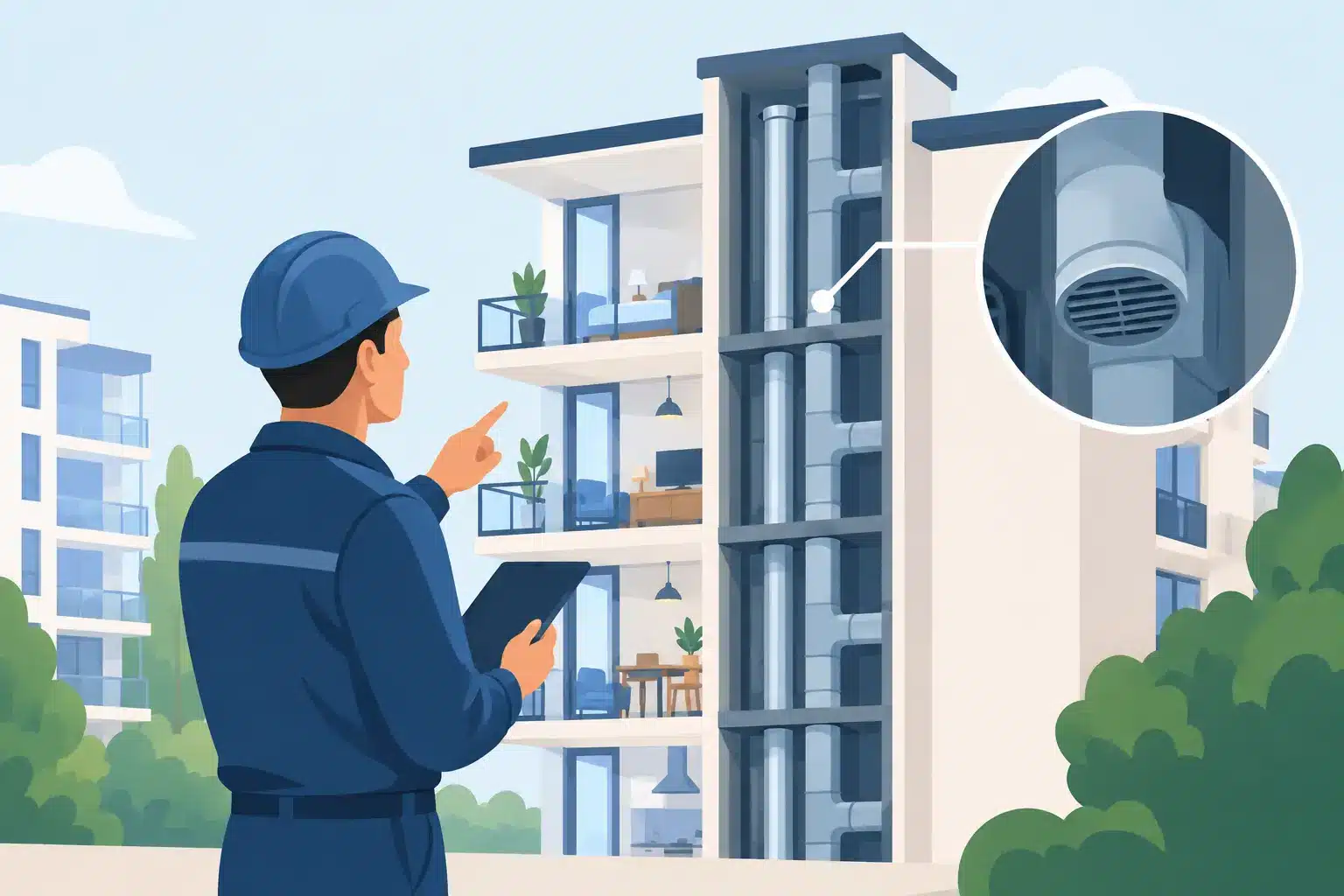
A persistent odor in the hallways, dust that keeps coming back quickly in the units, or drying that gets slower and slower are not just minor annoyances. They can signal that a ventilation system or a dryer duct needs professional attention. This condo duct maintenance guide helps condo boards, administrators and co-owners plan the right interventions at the right time, without confusing responsibilities or needlessly disturbing occupants.
Why Ducts Deserve a Maintenance Plan
In a condo building, air does not only circulate inside a single unit. Depending on how the building was designed, systems can serve private units, common areas or several floors. Ducts gradually accumulate fine dust, textile fibers, skin flakes, renovation residue and, sometimes, moisture. This buildup reduces the cleanliness of the system and can contribute to the circulation of odors or particles in occupied spaces.
The issue goes beyond comfort. A clogged system forces ventilation equipment to work harder, which can hurt its performance and speed up wear on certain components. In the case of dryers, lint that builds up in the duct also creates an overheating risk that should not be overlooked.
Structured maintenance therefore protects three essential things: indoor air quality, equipment performance and the value of the building. It also helps avoid reacting in an emergency after a repeated complaint, a breakdown or an avoidable incident.
Distinguishing Systems and Responsibilities
Before requesting a quote, the condo board must identify precisely which ducts are involved. The word “ducts” covers very different installations, which are not cleaned with the same method or at the same frequency.
Ventilation ducts can be connected to a central system, to air exchangers, to bathroom exhaust fans or to systems specific to certain units. Dryer ducts carry lint and hot air to the outside. Commercial kitchen networks or hoods in a common space require a specific protocol because of grease deposits.
The declaration of co-ownership, the building by-laws and existing maintenance contracts are the starting point. They make it possible to know whether the ducts are common areas, common areas for restricted use or elements under the co-owner’s responsibility. This distinction is decisive for sharing costs, obtaining the necessary access and communicating instructions clearly.
In older buildings, the actual routes of the ducts do not always match the available plans. An on-site inspection can then prevent a mandate that is too general from leaving out an important part of the system. It is better to define the scope before the work than to discover, once the intervention has started, that an access point or an exterior outlet was not planned for.
Signs That Justify an Intervention
There is no universal frequency that applies to all condos. It depends on the age of the building, the type of system, the number of occupants, the presence of pets, recent renovations and how appliances are used. A high-density tower is not managed like a small six-unit building with independent installations.
Certain signals, however, call for action without waiting for the next maintenance cycle:
- a dusty, stale or damp smell that returns despite cleaning;
- an unusual amount of dust near ventilation outlets;
- weak or uneven airflow in some areas;
- a dryer that needs several cycles to dry a normal load;
- renovation work that generated a lot of dust in or near air intakes.
These symptoms do not always prove that the ducts are the only cause. A clogged filter, a faulty fan, a blocked vent or a balancing problem can produce similar effects. This is why a professional approach starts with evaluating the system rather than with a standardized intervention.
Condo Duct Maintenance Guide: The Right Method
A serious intervention does not consist of quickly running a hose through a visible grille. Effective cleaning aims to dislodge deposits on the inner walls, capture them with suitable equipment and limit the recirculation of particles. The method chosen must respect the type of duct, its condition, its access points and the appliances connected to it.
1. Prepare the Mandate With the Condo Board
The condo board or the manager should establish which spaces will be visited, which units must provide access and which common areas will need to be protected. Written communication to residents reduces no-shows, delays and misunderstandings. It should indicate the planned period, the approximate duration of access to the unit and simple instructions, such as clearing the space around grilles or the dryer.
The quote must also specify the number of units, exterior outlets, main ducts, air exchangers and any equipment that is included or excluded. A clear price rests on a clear scope.
2. Inspect Before Cleaning
The technician checks access points, the visible condition of the ducts, vents, grilles, fans and outlets. This step makes it possible to spot crushed ducts, poorly secured connections, fragile materials or obstructions that need to be corrected before cleaning.
In the case of a dryer duct, the length of the route, the elbows and the condition of the exterior damper directly affect the level of buildup. A long, winding duct will generally need attention more often than a short, direct exhaust.
3. Clean With Capture and Controlled Agitation
Professional cleaning generally combines a vacuum source with suitable agitation tools. The goal is to loosen adhering particles while directing them toward a capture system, rather than pushing them further into the system.
Grilles, vents and accessible components are cleaned carefully. Finished surfaces, floors and nearby furniture must be protected, especially in occupied units. An experienced team adapts the technique to rigid or flexible ducts to avoid mechanical damage.
4. Check Related Components
Good maintenance does not stop at the ducts. Filters, air intakes, exterior grilles, fans and air exchangers all influence the quality of airflow. When a component is dirty, damaged or poorly fitted, the client should receive a precise recommendation rather than a vague promise.
A distinction must also be made between cleaning and repair. Cleaning removes deposits. It does not fix a water infiltration, active mold, a failing motor or a poorly installed line. These problems must be treated at their source.
How Often Should the Work Be Scheduled?
For dryer ducts, periodic inspection and cleaning are recommended, especially when several appliances use similar routes or when occupants notice slower drying. In a rental or condo building, the schedule must also take into account resident turnover and the actual use of the equipment.
For ventilation, it is preferable to rely on inspection, maintenance history and building conditions rather than applying an arbitrary frequency. After major renovations, water damage, a disaster or recurring complaints about odors and dust, an earlier evaluation is justified.
The condo board benefits from keeping a simple file: date of interventions, areas covered, observations, recommendations and corrective work carried out. This traceability makes budget preparation easier and demonstrates preventive management of the common areas.
Choosing a Provider for an Occupied Building
Price matters, but it should not be the only criterion. A condo mandate requires coordination, appropriate equipment and a method capable of limiting the impact on residents. Ask what is included, how access will be managed, what equipment will be used and how recommendations will be communicated after the work.
Experience in occupied buildings makes a concrete difference. Technicians must be able to work cleanly, respect the announced schedules and explain the limits of the intervention without dramatizing the situation. At Nettoyage Imperial, this approach relies on qualified technicians, safe procedures and cleaning adapted to the actual configuration of each building in Montreal, Laval, the North Shore and the South Shore.
Well-planned maintenance is not noticed for the noise it makes, but for the problems it avoids. By documenting the system, clarifying responsibilities and intervening before symptoms worsen, the condo board durably protects its occupants and its building.
How often should ducts be cleaned in a condo building?
There is no universal frequency. It depends on the age of the building, the type of system, the number of occupants, the presence of pets, recent renovations and how appliances are used. For dryer ducts, periodic inspection and cleaning are recommended, especially when several appliances share similar routes or drying becomes slower. For ventilation, it is better to rely on inspection, maintenance history and building conditions. An earlier evaluation is justified after major renovations, water damage, a disaster or recurring complaints about odors and dust.
Who is responsible for duct maintenance in a condo?
It depends on the building. The declaration of co-ownership, the building by-laws and existing maintenance contracts show whether the ducts are common areas, common areas for restricted use or elements under the co-owner’s responsibility. This distinction determines how costs are shared, how access is obtained and how instructions are communicated.
What are the signs that condo ducts need cleaning?
Warning signs include a dusty, stale or damp smell that returns despite cleaning, unusual dust near ventilation outlets, weak or uneven airflow, a dryer that needs several cycles to dry a normal load, and renovation work that created a lot of dust near air intakes. These symptoms do not always prove the ducts are the only cause, since a clogged filter, a faulty fan, a blocked vent or a balancing problem can have similar effects. That is why the system should be evaluated first.
What does professional duct cleaning involve?
It starts with an inspection of access points, the visible condition of the ducts, vents, grilles, fans and outlets. The cleaning then combines a vacuum source with suitable agitation tools to loosen deposits and direct them into a capture system. Related components such as filters, air intakes, exterior grilles, fans and air exchangers are also checked. Cleaning removes deposits, but it does not fix a water infiltration, active mold, a failing motor or a poorly installed line.
What should a condo board look for when choosing a duct cleaning provider?
Price matters, but it should not be the only criterion. Ask what is included, how access will be managed, what equipment will be used and how recommendations will be communicated after the work. Experience in occupied buildings also matters, because technicians need to work cleanly, respect announced schedules and explain the limits of the intervention without dramatizing the situation.
Key Takeaways
- Ducts gradually collect dust, fibers, debris and sometimes moisture, so a structured maintenance plan protects indoor air quality, equipment performance and the value of the building.
- Before asking for a quote, identify which ducts are involved and who is responsible, using the declaration of co-ownership, the building by-laws and existing maintenance contracts.
- There is no universal cleaning frequency. Base the decision on the building, the system and warning signs such as returning odors, excess dust, weak airflow or a slow dryer.
- A proper intervention inspects first, cleans with capture and controlled agitation, and checks related components. Cleaning removes deposits but does not repair other problems.
- Choose a provider on more than price, and keep a simple record of dates, areas covered, observations, recommendations and corrective work.