

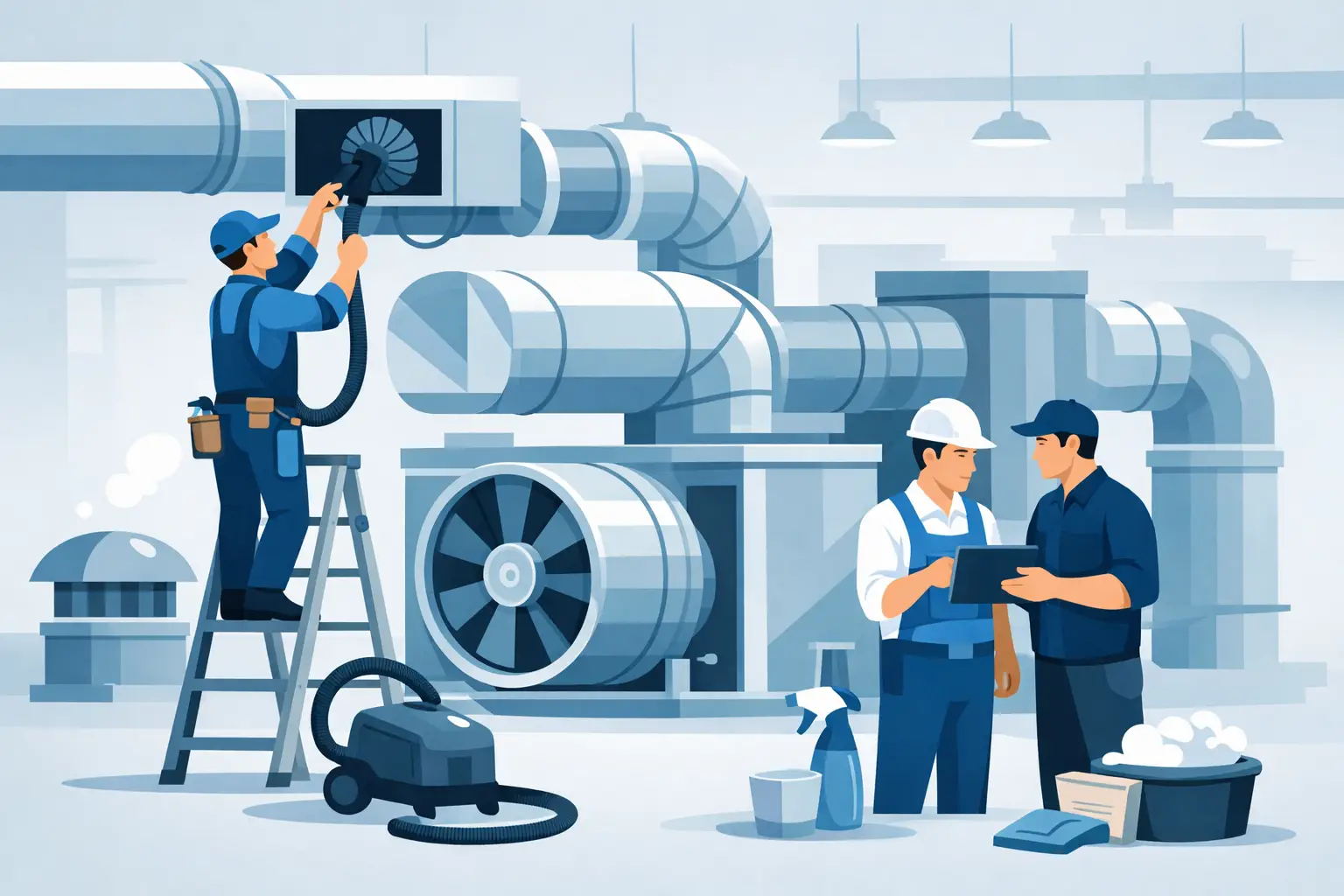
A poorly maintained commercial ventilation system rarely announces itself right away. Yet it quietly affects indoor air quality, occupant comfort, cleanliness, and equipment performance every single day. This commercial duct cleaning guide is here to help you understand when to act, what to inspect, and why consistent commercial ventilation duct maintenance protects your employees, your clients, and your building.
In an office, retail space, clinic, or mixed use commercial building, ducts gradually collect fine dust, grease particles, and airborne contaminants. The effects vary by setting. In administrative environments, buildup tends to worsen odours and comfort complaints. In busier or more technical spaces, it can also reduce airflow, strain equipment, and speed up wear on the system.
Why Commercial Ventilation Duct Maintenance Should Never Be Delayed
Putting off duct cleaning can seem like a way to save money in the short term. In practice, it usually costs more. The longer buildup sits, the harder the system has to work to maintain proper airflow. Fans run harder, filters clog faster, and settled particles can circulate back into occupied spaces.
There is also the image of your business to consider. In commercial spaces open to the public, heavy air, lingering odours, or dust that returns quickly after cleaning signal a lack of control to visitors and staff alike. For property managers and business owners, these are signs worth taking seriously.
Regular commercial ventilation duct maintenance also reduces the risk of unplanned, urgent repairs. A well planned cleaning schedule almost always costs less than an emergency call triggered by complaints, poor performance, or a contamination problem that has gone too far.
How Often to Clean Commercial Ducts?
There is no single frequency that fits every building. The right schedule depends on the type of business, hours of occupancy, the presence of specific dust sources, filter condition, and how the ventilation network is configured.
For a typical office, a periodic check that includes a visual inspection and a general condition assessment is usually enough to build a reliable schedule. For high traffic retail spaces, daycares, clinics, or certain food service environments, how often to clean commercial air ducts becomes a more frequent question, since these spaces demand closer attention. Older buildings or those that recently underwent renovations also need extra vigilance, since construction work often pushes particles deep into the duct network.
The most reliable approach is a methodical one. Cleaning should happen because the actual condition of the system calls for it, not because a date appeared on a calendar. This avoids two common mistakes: waiting too long, or scheduling service too often without any real benefit.
Warning Signs Your Commercial Ducts Need Maintenance
Several indicators can help you catch a maintenance need before it becomes a bigger problem. Increased dust buildup around diffusers, odours that persist even after cleaning, uneven comfort between zones, or airflow that feels noticeably weaker are all common warning signs.
Some businesses also notice more complaints related to indoor air, including heavy or stuffy air, respiratory discomfort, irritation, or difficulty maintaining a stable temperature. This does not always mean the ducts are the sole cause. Still, it is often a useful signal to trigger a full inspection of the ventilation system as part of routine commercial ventilation duct maintenance.
It is also worth paying close attention after a minor incident such as water damage, construction work, or a change in how the space is used. These events shift the balance of the building and can introduce contaminants into the ducts that were not there before.
What a Proper Commercial Duct Cleaning Guide Should Cover
Genuine maintenance goes well beyond vacuuming a few visible vents. In a commercial setting, the work needs to follow a system wide approach. It starts with an assessment of the installation, its access points, its current level of buildup, and any critical zones.
From there, cleaning should target the entire duct network using equipment suited to duct diameter, the type of buildup, and the sensitivity of the site. Most professional methods combine mechanical agitation with negative pressure extraction, which loosens contaminants and captures them without releasing them back into occupied spaces.
Related components deserve attention too. Diffusers, grilles, dampers, and certain sections of the air handling unit can all contribute to the problem if they are overlooked. A reliable commercial duct cleaning guide from any provider should clearly explain what is included, what is not, and the order in which the work will be carried out.
Common Mistakes in Commercial Ventilation Duct Maintenance
The first mistake is choosing a provider based on price alone. A very low quote often hides a partial, rushed, or poorly documented job. In commercial buildings, this creates a false sense of security without actually addressing the root cause of the buildup.
The second mistake is confusing duct cleaning with filter replacement. Filters matter, but they are not a complete solution. If the network is already carrying heavy buildup, filter changes alone will not restore optimal conditions.
The third mistake is ignoring recurring causes. If ducts get dirty unusually fast, it is worth checking filtration quality, sealed sections, cleaning practices, recent construction, or the nature of the activities carried out in the space. Cleaning without correcting these factors usually just delays the problem by a few months.
Preventive Maintenance or a One Time Service
The right choice depends on the building and its level of exposure. A one time service can be enough after construction work or when an inspection reveals localized buildup. For a property portfolio, a busy commercial space, or a building with strict air quality requirements, a preventive strategy is usually the more cost effective option.
A preventive approach to commercial ventilation duct maintenance helps spread out costs, limit disruptions, and maintain a clearer picture of the system’s condition over time. It also makes it easier to coordinate with other technical work, such as air exchanger servicing, HVAC unit maintenance, or hood cleaning in certain settings. This kind of planning avoids last minute, urgent decisions.
That said, prevention only adds value when it is proportionate. A program that is too aggressive increases costs without real benefit. A program that is too light lets problems drift. The right balance comes from inspection data, building history, and how the space is actually used.
The Real Benefits of a Clean Commercial Duct Network
When ducts are properly maintained, the results are noticeable. Air circulates more consistently, stale odours fade, surfaces stay cleaner longer, and occupants generally feel more comfortable.
On the operational side, consistent commercial ventilation duct maintenance also helps protect equipment by reducing unnecessary strain. It will not turn an aging system into a brand new one, but it does help maintain more stable operating conditions, which is already a meaningful win for any responsible manager.
Finally, there is a less visible but important benefit: control. Knowing the true condition of your ventilation network, acting at the right time, and documenting the work done allows you to manage a building with more precision. In a commercial setting, that discipline is often what separates reactive maintenance from a well run operation.
How often should businesses schedule commercial ventilation duct maintenance?
There is no single answer for every building. Frequency depends on occupancy, activity type, filter condition, and duct configuration. Most commercial spaces benefit from a periodic inspection to determine the right schedule, rather than cleaning on a fixed calendar date regardless of actual need.
How often to clean commercial air ducts in a high traffic retail space?
High traffic retail spaces, clinics, daycares, and food service environments typically need more frequent attention than a standard office. How often to clean commercial air ducts in these settings should be based on inspection findings, since heavier occupancy speeds up buildup.
What does a professional commercial duct cleaning guide typically include?
A proper commercial duct cleaning guide covers a full system assessment, mechanical agitation combined with negative pressure extraction, and attention to related components like diffusers, grilles, and dampers. It should also clearly outline what is included and what is not before work begins.
What are the signs that commercial ducts need cleaning?
Common signs include visible dust buildup around diffusers, persistent odours, uneven airflow between zones, and an increase in indoor air complaints. Recent construction, water damage, or a change in how the space is used are also good reasons to schedule an inspection.
Is preventive commercial ventilation duct maintenance worth the cost?
For busy commercial buildings or properties with strict air quality needs, yes. Preventive commercial ventilation duct maintenance spreads out costs, reduces disruptions, and avoids the higher expense of emergency service triggered by complaints or performance issues.
Key Takeaways
- Consistent commercial ventilation duct maintenance prevents costly emergency repairs and protects indoor air quality.
- How often to clean commercial air ducts depends on occupancy, activity type, and inspection findings, not a fixed calendar date.
- A trustworthy commercial duct cleaning guide should explain the full scope of work, including components covered and access requirements.
- Warning signs like persistent odours, visible dust, and uneven airflow should never be ignored.
- Preventive commercial ventilation duct maintenance is generally more cost effective than reactive, one time service for busy commercial buildings.
- Choosing a provider based on price alone often leads to incomplete or poorly documented cleaning.