

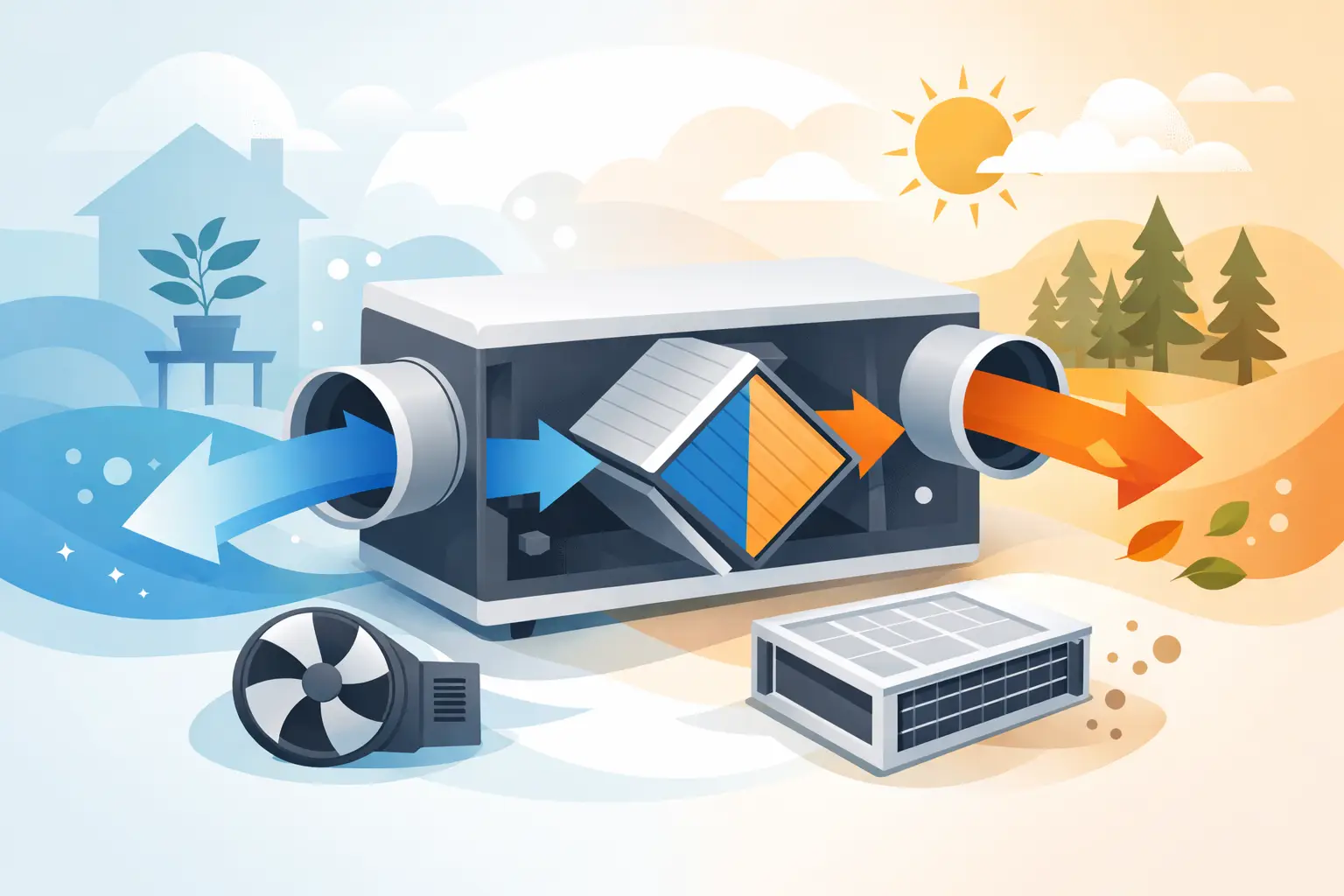
When an air exchanger runs continuously, it accumulates far more than dust. Fine particles, greasy residue, moisture, and sometimes early-stage mould settle into the filters, the heat recovery core, connecting ducts, and internal components. This is exactly why clean air exchanger maintenance is not a minor detail but a direct measure to protect indoor air quality, system performance, and daily comfort. Understanding the dirty air exchanger health effects that build up over time is the first step toward making smarter decisions about your home or building’s ventilation.
Why Clean Air Exchanger Units Directly Affects the Air You Breathe
The job of an air exchanger is to renew indoor air by exhausting stale air and drawing in fresh air from outside. In theory, it sounds straightforward. In practice, a dirty system loses a significant portion of its efficiency and can end up redistributing contaminants rather than improving the indoor environment. This is one of the most underappreciated dirty air exchanger health effects that homeowners encounter without always connecting it to the source.
In a family home or commercial space, the air constantly carries dust, allergens, textile fibres, cooking particles, and residue from everyday activities. Some of these contaminants are captured by the filters, but others accumulate deep inside the unit. Over time, this buildup disrupts airflow and increases the risk of stale, lingering odours throughout the space which is why clean air exchanger is necessary.
For sensitive occupants, the effects often appear before any mechanical failure occurs. Heavier air, a persistent sense of dampness, dust that returns quickly after cleaning, respiratory irritation, and general discomfort are all common signals. Cleaning alone does not transform the entire air quality of a building, but it removes a real source of contamination and allows the system to do what it was actually designed to do. The benefits of cleaning HRV unit components go well beyond odour control.
A Dirty Air Exchanger Works Harder and Wears Out Faster
A clogged air exchanger must compensate for the resistance created by internal deposits. The fans strain harder, airflow becomes less consistent, and certain components absorb unnecessary mechanical stress. The issue is not always immediately obvious because the unit may keep running despite a gradual decline in performance. This is a key reason why clean air exchanger routines should not be put off until something breaks.
Neglected maintenance often ends up costing far more than it appears to save. Energy consumption may start modestly higher, then climb as filters saturate and the core becomes obstructed. In some cases, the motor wears prematurely, heat recovery performance drops, and repair costs end up far exceeding what a preventive service would have cost. The benefits of cleaning HRV unit systems regularly are just as much financial as they are health-related.
Montreal’s cold season adds another layer of importance. A clean system maintains more stable air exchanges when buildings are sealed for extended periods. A neglected unit can contribute to ventilation imbalances and make interior humidity far harder to manage, amplifying the dirty air exchanger health effects that occupants already feel during long winters.
The Parts Most Affected by Buildup Inside Your Unit
Most homeowners think primarily about filters when it comes to air exchanger upkeep, and while filters matter, they are only part of the picture. The heat recovery core, intake and exhaust ports, the condensate tray, nearby duct sections, and the fans can all retain debris that compromises overall system performance. Understanding why clean air exchanger maintenance covers more than just filters is essential to getting real results.
Filters play a frontline role, but when they are overloaded, they stop filtering effectively and partially restrict airflow at the same time. They are usually the easiest element to inspect, but that is not a reason to stop there. An air exchanger can look fine from the outside while being heavily fouled inside, which is precisely where dirty air exchanger health effects originate without obvious warning signs.
The Benefits of Cleaning HRV Unit Go Beyond Eliminating Odours
Odours are among the most common reasons homeowners call for service, but they only tell part of the story. A dirty unit can also contribute to poorly controlled humidity, increased airborne particles, and uneven air distribution between rooms. These are real and measurable dirty air exchanger health effects that affect comfort long before they become visible problems.
In a home, you might notice windows fogging more than usual, an enclosed feeling in certain rooms, or inconsistent fresh air distribution. In a rental building or commercial space, the stakes are even higher because multiple occupants depend on the system working consistently. Regular upkeep becomes a matter of operational reliability, not just personal comfort. The benefits of cleaning HRV unit systems in multi-occupant properties directly affect the quality of life for everyone inside.
There is also a hygiene dimension that should not be minimized. When dust and moisture combine inside a ventilation unit, microbial risk increases. Not every situation leads to severe contamination, but waiting until the problem becomes visible is never a sound strategy. In technical maintenance, early intervention is almost always what prevents more serious and costly outcomes. This is fundamentally why clean air exchanger service should be scheduled before problems develop.
When to Clean and How Often to Schedule Service
The right answer depends on how the building is used, the number of occupants, the presence of pets, ambient air quality, and the surrounding environment. A home with children, pets, and active heating for most of the year accumulates very different levels of buildup than a lightly occupied unit. A commercial space is exposed to more particles or cooking odours which is why clean air exchanger is necessary to keep and commercial space also requires closer attention.
In practice, periodic filter checks are non-negotiable, while a more thorough cleaning should be planned to avoid dirty air exchanger health effects. There is no single universal schedule. A professional approach starts with an inspection and then delivers a recommendation tailored to the specific unit and usage, rather than applying a one-size-fits-all timeline.
Understanding the benefits of cleaning HRV unit systems is important, as regular maintenance improves airflow efficiency, reduces strain on the system, and helps maintain healthier indoor air. Both over-servicing and under-servicing miss the mark. The goal is to intervene at the right moment, with the right level of care, which is the foundation of genuinely useful HRV cleaning and maintenance.
What Professional Air Exchanger Cleaning Actually Includes
Cleaning an air exchanger is not simply a matter of pulling out a filter and wiping down the exterior casing. A professional service addresses the full functional system. It involves disassembling the unit, inspecting and cleaning critical components, assessing the overall condition of the equipment, and identifying signs of wear before they develop into failures. This is the core of why clean air exchanger service from a trained technician delivers results that a surface wipe-down cannot.
The method also matters to avoid dirty air exchanger health effects. Not every product, pressure level, or cleaning technique is appropriate for heat recovery cores, fans, or plastic components. A poorly executed cleaning can shift the problem rather than solve it or reduce the unit’s performance rather than restore it. The benefits of cleaning HRV unit systems are only fully realized when the service is done correctly and completely.
For homeowners and property managers, the return is twofold. Air circulates more freely and the system breathes again, and the maintenance contributes directly to protecting a long-term investment. Replacing an air exchanger costs significantly more than maintaining one properly. This is the approach that Nettoyage Imperial brings to every residential and commercial service call in Montreal, Laval, the North Shore, and the South Shore.
Why clean your air exchanger if it still seems to be running fine?
This is one of the most common misconceptions about ventilation maintenance. A unit can continue operating while losing significant efficiency and producing real dirty air exchanger health effects such as increased dust, heavier air, and moisture imbalances. Understanding why clean air exchanger maintenance matters means recognizing that performance decline is gradual, not sudden.
What are the main benefits of cleaning an HRV unit professionally?
The benefits of cleaning HRV unit systems go well beyond fresh-smelling air. A clean unit restores proper airflow, reduces strain on the motor and fans, improves heat recovery efficiency, manages indoor humidity more effectively, and reduces the circulation of allergens and fine particles. For households in Montreal and surrounding areas where homes are sealed for long winters, these benefits are especially significant.
What are the dirty air exchanger health effects I should watch for?
The most common dirty air exchanger health effects include increased dust settling on surfaces shortly after cleaning, persistent stale or musty odours, a general sense of heavy or stuffy air, worsening allergy or respiratory symptoms, and higher humidity or window condensation. These signs often appear gradually, which is why connecting them to the air exchanger requires some awareness.
How does HRV cleaning and maintenance differ from just changing filters?
Changing filters is an important first step, but the benefits of cleaning HRV unit are far more including the heat recovery core, fans, condensate tray, exhaust and intake ports, and nearby duct connections. Each of these components can accumulate buildup that affects performance even when the filters themselves look relatively clean. A complete service addresses all of them.
How do I know when to call a professional instead of cleaning it myself?
Basic filter checks can be handled by most homeowners. However, if you notice any of the dirty air exchanger health effects described above, if the unit has not been professionally serviced in over a year, or if you are unsure about the condition of the heat recovery core or internal components, it is time to call a professional. Nettoyage Imperial serves homeowners and property managers throughout Montreal, Laval, North Shore, and South Shore with structured, reliable HRV cleaning and maintenance services.
Key Takeaways
- Why clean air exchanger units regularly comes down to health, system efficiency, and long-term cost savings, not just odour control.
- Common dirty air exchanger health effects include increased dust, heavier indoor air, persistent odours, humidity imbalances, and worsening respiratory symptoms.
- The benefits of cleaning HRV unit systems extend to the heat recovery core, fans, condensate tray, and duct connections, not just the filters.
- HRV cleaning and maintenance frequency should be based on actual system condition, occupancy levels, and building use rather than a fixed universal schedule.
- A professionally cleaned air exchanger reduces energy strain, extends equipment life, and delivers measurably better indoor air quality.
- Montreal, Laval, North Shore, and South Shore homeowners face long sealed winters which is why clean air exchanger maintenance becomes especially critical for year-round comfort.