

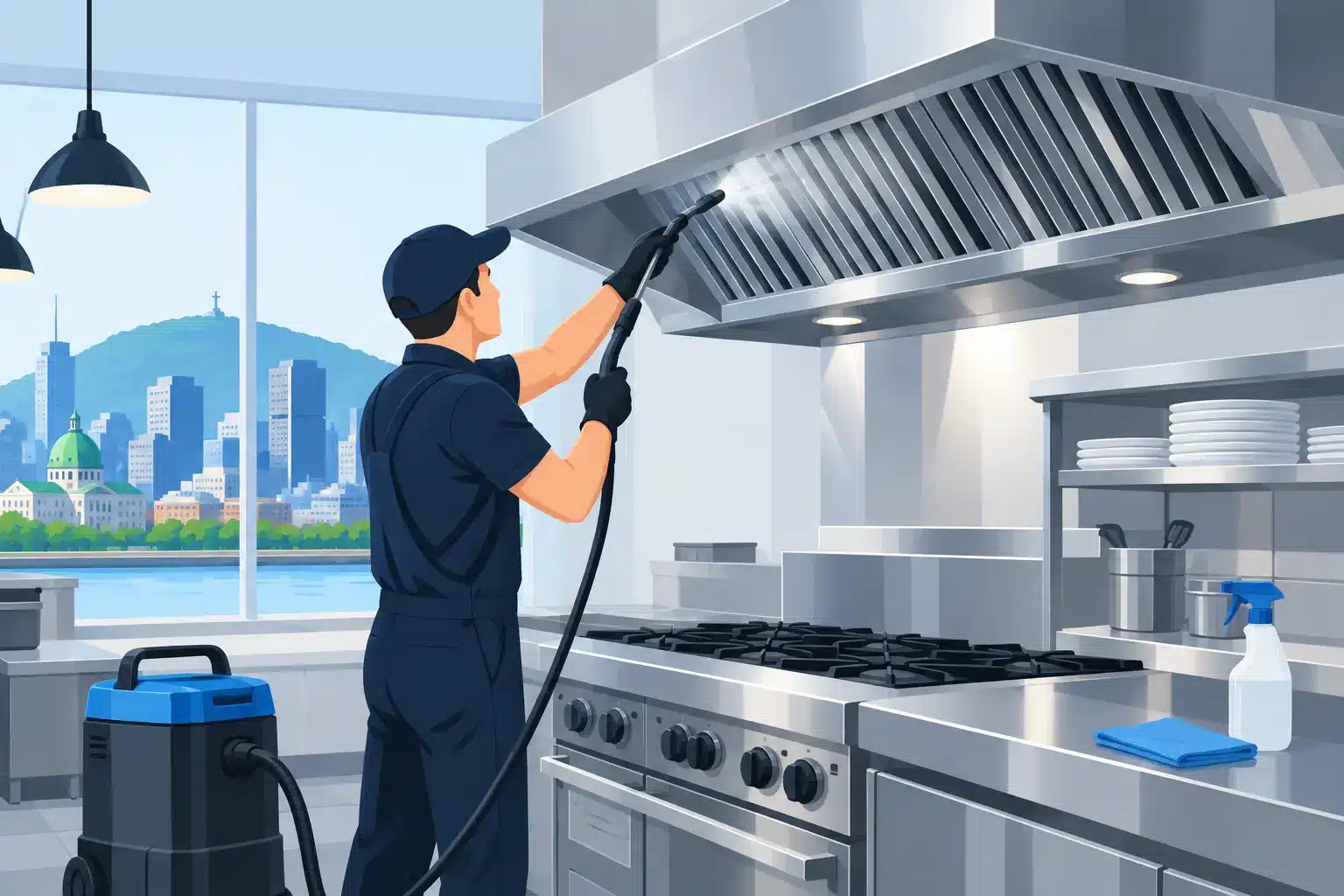
A commercial kitchen hood is not simply a piece of equipment to wipe down at the end of a shift. It traps greasy vapors that migrate into the filters, the ducts and the exhaust fan. The question “who cleans restaurant hoods” therefore relates directly to fire prevention, kitchen hygiene and business continuity.
For a restaurant, café, cafeteria or institutional kitchen in Montreal, Laval, on the North Shore or the South Shore, the right person for the job is a specialist in commercial kitchen exhaust system cleaning. Their work is not limited to the visible part of the hood. They must treat the entire path the grease follows, all the way to the fan located on the roof or in the building’s mechanical room.
Who Cleans Restaurant Hoods?
Technicians Trained for Grease Exhaust Systems
Restaurant hood cleaning is handled by technicians trained to work on grease exhaust systems. They use protective equipment, containment methods and suitable products to degrease the components without contaminating food preparation areas, walls, ceilings or neighboring equipment.
Regular housekeeping is still useful for accessible surfaces and filters, according to the manufacturer’s instructions. However, it does not replace a professional cleaning of the complete system. The riskiest deposits are often out of reach: behind the filters, in the plenum, inside the ducts and around the exhaust fan. That is precisely where a fire can spread quickly.
Cooking Equipment Changes the Cleaning Needs
The chosen provider must understand the particularities of commercial kitchens. A hood serving a fryer, a grill, a wok or open-flame cooking equipment produces a very different grease load than a kitchen that mainly reheats prepared food. The method, the time required and the maintenance frequency must be adjusted to that reality.
What Does a Professional Cleaning Include?
Steps of a Thorough Cleaning
A serious intervention begins with a visual inspection of the system and the protection of work surfaces. The technician removes or treats the filters, degreases the inside of the hood, accesses the ducts when their configuration allows it and cleans the exhaust fan. The residue is collected and the affected areas are cleaned before the system is put back into service.
The desired result is not only a hood that looks cleaner. The goal is to reduce the buildup of combustible grease along the exhaust path. A good service also leaves a clear record of the work: date, scope of work, areas cleaned and recommendations if a component needs special attention.
Why the Documentation Matters
This documentation can be useful during an internal inspection, a fire department visit, a check by an insurer or a change of manager. It shows that maintenance was planned rather than postponed until a problem appeared.
Why Is Grease in the Ducts a Major Risk?
Cooking generates a combination of heat, smoke, moisture and greasy particles. Some of these particles are captured by the filters, but others continue through the system. Over time, they form a sticky layer that traps even more dirt.
When a Flare-Up Reaches the Hood
When a flare-up occurs on a cooking appliance, flames can reach the hood. If the ducts contain a significant amount of grease, the fire can progress beyond the kitchen and become much harder to control. A fire suppression system is essential, but it never replaces periodic degreasing of the exhaust network.
Effects on Ventilation and Comfort
The buildup can also reduce ventilation efficiency. The kitchen then becomes hotter, smokier and less comfortable for the team. Odors can spread into the dining room or to other areas of the building. In the long term, a fouled fan works harder and may need premature repairs.
How Often Should a Commercial Hood Be Cleaned?
The answer depends on cooking volume, menu type, the appliances used and the requirements that apply to your establishment. There is no single reasonable frequency for all kitchens. A very busy restaurant that makes heavy use of fryers, grills and cooktops will generally need to schedule cleanings more often than a small establishment with low grease production.
General Frequency Guidelines
As a general guide, kitchens that use solid fuel may require monthly maintenance. High-volume cooking operations are often scheduled quarterly. For moderate activity, a semi-annual interval may be appropriate, while some low-use facilities may be serviced annually. These guidelines must nonetheless be confirmed according to the actual condition of the system, the manufacturer’s recommendations, the insurer’s requirements and the local authority’s rules.
Waiting until a grease smell persists, the hood drips or the filters look black is rarely a good strategy. At that stage, the visible deposits often represent only part of the buildup. A preventive maintenance schedule makes it possible to plan the intervention at a time that disrupts service less and avoids the expense caused by an emergency.
How to Recognize a Qualified Provider?
Price is a legitimate criterion, but it should not be the only one. A very low quote may leave out essential steps, such as access to the ducts, cleaning of the fan or adequate protection of the kitchen. Before choosing a supplier, ask clearly which components are included and whether a service report is provided.
Questions a Reliable Professional Asks
A reliable professional also asks precise questions: which appliances are used, how many hours a day the kitchen operates, where the fan is located, when the last cleaning was done and whether any odor, smoke or backdrafting problems have been noticed. This information gathering makes it possible to set a realistic scope of work rather than applying an identical flat rate to every kitchen.
Also check that the company holds the necessary insurance, that its technicians use safe methods and that it can work within your operational constraints. In a commercial kitchen, cleanliness after the work matters as much as the degreasing itself. Food surfaces, equipment, floors and access areas must be protected rigorously.
Nettoyage Imperial’s Approach
Nettoyage Imperial offers a commercial hood cleaning service with a structured approach, professional equipment and scheduling adapted to establishments in Montreal and surrounding markets. The goal is to provide a complete, documented intervention that is compatible with the requirements of a working kitchen.
Preparing Your Kitchen Before the Appointment
Scheduling and Access
A simple preparation helps the technicians work efficiently. Ideally, schedule the cleaning after opening hours or during a period of reduced production. Clear access under the hood and around the affected equipment, then inform the kitchen team of the scheduled time so that no appliance is turned back on during the work.
The provider may ask that certain equipment be cooled, that food be put away and that preparation areas be cleared. These measures do not complicate service: they protect food products and reduce the time the kitchen is out of operation. If the installation has difficult access, a rooftop fan or long ducts, mention it as soon as you request a quote.
After the Cleaning
After the intervention, keep the report and note the next recommended date. This habit makes follow-up easier, even when responsibilities change between an owner, a chef, a manager or a property manager.
A clean hood should never depend on a last-minute reminder or an imminent inspection. By choosing a specialist who can assess your kitchen and maintain the entire exhaust system, you protect your team, your building and the reputation of your establishment.
Who cleans restaurant hoods?
Restaurant hoods are cleaned by technicians trained to work on grease exhaust systems, ideally specialists in commercial kitchen exhaust system cleaning. They use protective equipment, containment methods and suitable products, and they treat the entire path the grease follows, all the way to the fan on the roof or in the building’s mechanical room.
How often should a commercial kitchen hood be cleaned?
It depends on cooking volume, menu type, the appliances used and the requirements that apply to your establishment. As a general guide, kitchens using solid fuel may need monthly cleaning, high-volume operations are often scheduled quarterly, moderate activity may call for a semi-annual interval, and some low-use facilities may be serviced annually. These guidelines should be confirmed according to the real condition of the system, the manufacturer’s recommendations, the insurer’s requirements and the local authority’s rules.
What does a professional hood cleaning include?
A professional cleaning starts with a visual inspection and the protection of work surfaces. The technician removes or treats the filters, degreases the inside of the hood, accesses the ducts when their configuration allows it and cleans the exhaust fan. The residue is collected, the affected areas are cleaned, and a good service leaves a record with the date, scope of work, areas cleaned and any recommendations.
Can restaurant staff clean the hood themselves?
Regular housekeeping is useful for accessible surfaces and filters, following the manufacturer’s instructions. However, it does not replace a professional cleaning of the complete system. The riskiest deposits are often out of reach: behind the filters, in the plenum, inside the ducts and around the exhaust fan.
Why is grease in kitchen exhaust ducts a fire risk?
Cooking leaves a sticky layer of grease in the system over time. If a flare-up reaches the hood and the ducts hold a significant amount of grease, the fire can progress beyond the kitchen and become much harder to control. A fire suppression system is essential, but it never replaces periodic degreasing of the exhaust network.
Key Takeaways
- A commercial kitchen hood is only the visible part of a system. Grease travels into the filters, the ducts and the exhaust fan, so the whole path needs to be cleaned.
- Restaurant hoods should be cleaned by a specialist in commercial kitchen exhaust system cleaning. Regular housekeeping is useful for accessible surfaces and filters but does not replace a professional cleaning of the complete system.
- Grease buildup in the ducts is a major fire risk. It can also reduce ventilation efficiency, spread odors and make the fan work harder. A fire suppression system never replaces periodic degreasing.
- Cleaning frequency depends on cooking volume, menu type and appliances. General guidelines are monthly for solid fuel, quarterly for high-volume cooking, semi-annual for moderate activity and annual for low use, all to be confirmed with the manufacturer, the insurer and the local authority.
- Choose a provider on more than price. Ask what is included, whether a service report is provided, and check insurance and safe methods. Keep the report and note the next recommended date.