

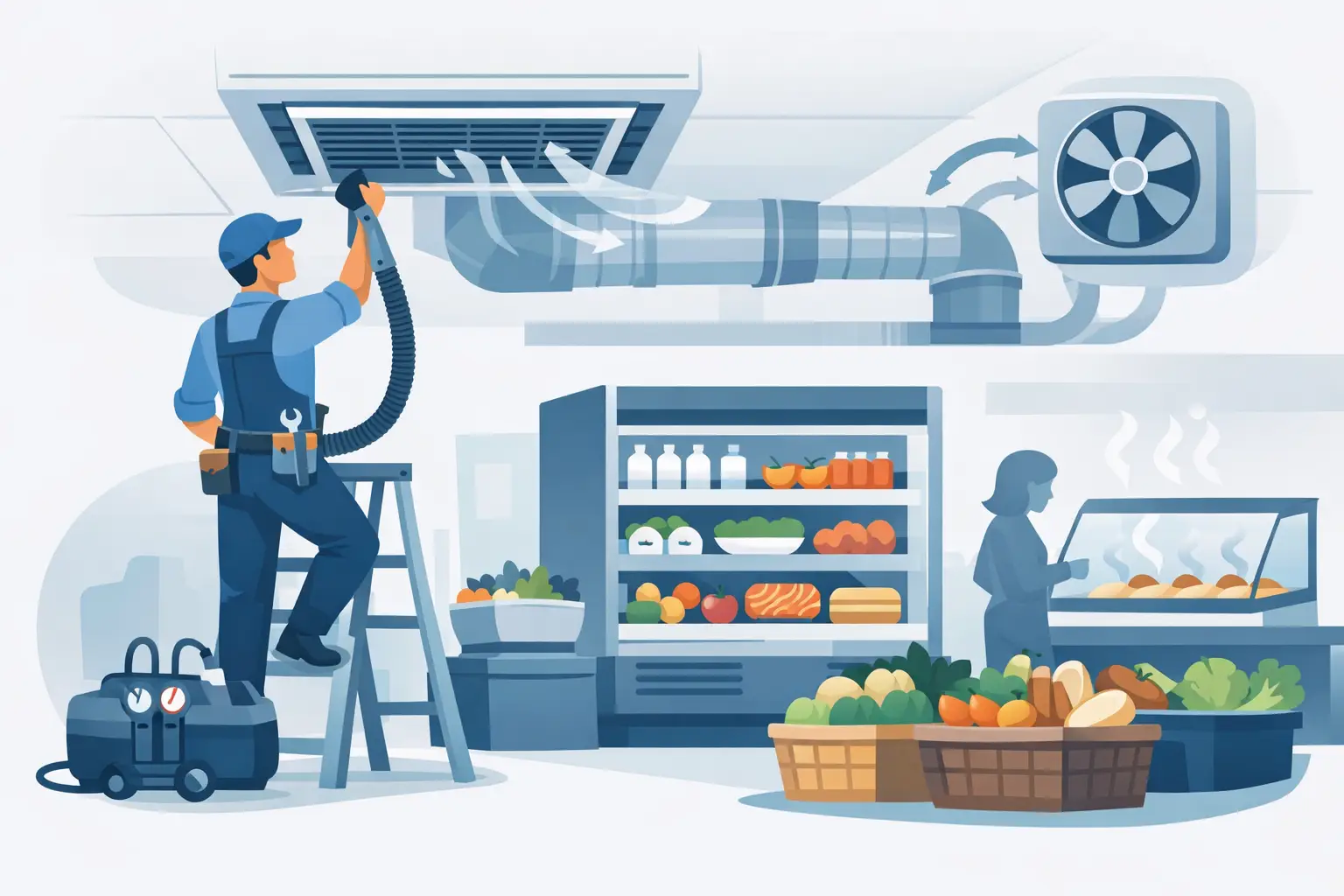
A fryer smell that lingers in the dining room after service, condensation on display cases, a hood that’s gotten noisier, or heat that’s hard to clear — these aren’t just minor annoyances. In any establishment where food is prepared, stored, or sold, ventilation maintenance for a food business has a direct impact on hygiene, staff comfort, customer perception, and the safety of the installations.
Ventilation often works quietly in the background, until the day it no longer keeps up. Grease, dust, food particles, and moisture residue build up gradually in filters, ducts, vents, and equipment. Waiting for a breakdown or an unfavorable inspection usually costs more than a planned maintenance program.
Why Ventilation Deserves Special Attention
- Different zones, different needs: In a shop, grocery store, bakery, café, or restaurant, air moves between several zones with very different needs. The kitchen produces heat, steam, and grease. The sales areas host customers. Storage rooms may hold packaging, dry goods, or products sensitive to odors and humidity.
- What happens when extraction falls short: When extraction is insufficient or fresh air isn’t properly balanced, contaminants don’t clear the way they should. Odors migrate, surfaces get dirty faster, and the overall atmosphere becomes less pleasant. For employees, heavy air can also add to the discomfort of long prep or cooking shifts.
- More than an appearance issue: The stakes go beyond appearance. A buildup of grease in cooking-related extraction components increases the risk of a fire spreading. Conversely, dust-laden ducts in sales and storage areas can hurt overall air quality. Each system needs to be assessed based on its actual use, not on a frequency chosen at random.
Food Business Ventilation Maintenance: What Frequency Should You Plan?
There’s no single schedule that fits every business. The right frequency depends on cooking volume, the type of food prepared, operating hours, the condition of the system, and the requirements of your insurer, the manufacturer, or the relevant authorities.
Cooking volume changes the equation. A counter that occasionally reheats packaged products doesn’t generate the same load as a kitchen that uses fryers, grills, ovens, or cooktops every day. Businesses with high grease output need much closer monitoring of their hoods, filters, and extraction ducts.
Day-to-day checks matter as much as deep cleans. In practice, accessible filters should be checked frequently and cleaned as soon as buildup visibly reduces airflow. Regularly inspecting vents, fans, belts, exterior grilles, and air intakes also helps catch problems before they disrupt service.
Documentation supports the whole program. For deep cleaning of ducts and technical components, a professional sets a frequency based on the condition observed. This can be shorter for an intensive kitchen and more spread out for a business without significant cooking. The key point is documenting each intervention — dates, areas treated, observations, and recommended work. This record-keeping makes managing the business easier and provides useful evidence during an inspection or an insurer’s request.
Don’t Confuse Duct Maintenance with Hood Cleaning
What hood cleaning covers
The kitchen hood captures smoke, vapor, and some grease at the source. Cleaning it typically involves the filters, accessible surfaces, the plenum, the extraction ducts, and sometimes the rooftop fan. This is a specialized service focused on controlling grease deposits and preventing fire risk.
What general duct maintenance covers
General ventilation duct maintenance addresses a different need. It targets the networks that distribute or extract air throughout dining rooms, storage areas, offices, and other parts of the business. Both services may be needed in the same establishment, but they aren’t interchangeable. A clean duct doesn’t remove grease from a cooking extraction system, just as a degreased hood doesn’t guarantee a clean general ventilation network.
Signs That Cleaning Is Becoming Necessary
- Airflow and equipment clue: Some signs are easy to spot, as long as they aren’t dismissed. A drop in airflow at the vents, filters that blacken quickly, persistent heat in the kitchen, or an unusually noisy fan all warrant a check. Likewise, if cooking odors reach the dining room, storage areas, or customers’ clothing, it’s worth examining how well the extraction is working and whether exhaust and makeup air are properly balanced.
- Condensation as a warning sign: Condensation is another signal to watch for. It can appear on display cases, walls, ceilings, or around vents. It encourages humidity and can, depending on the context, damage finishes, cardboard packaging, and certain stock. Poorly balanced air pressure can also make doors hard to open or create uncomfortable drafts near service areas.
- Rising energy use: Finally, an unusual increase in energy consumption can point to a system working harder to compensate for buildup. A clogged filter or an unbalanced fan forces the equipment to work overtime. Cleaning won’t fix every mechanical failure, but it does help distinguish a maintenance issue from a repair issue.
What Professional Maintenance Should Include
Starting with an assessment
A thorough service begins with identifying the networks present and what each one does. The technician checks access points, the condition of grilles, visible buildup, equipment operation, and the most exposed areas. This step avoids applying the same method to a dining-room air duct and to a grease-laden extraction duct.
Cleaning methods that protect the space
Cleaning must then be carried out with the right equipment to loosen contaminants without dispersing them through the business. Controlled vacuuming, mechanical brushing where needed, and protecting work areas are all essential. In a food environment, how the job is organized matters as much as the result — food products, prep surfaces, and display units need to be protected or the work scheduled outside production hours.
Closing out with an inspection and report
After cleaning, a final inspection confirms the condition of access points and flags anything that needs attention, such as a damaged filter, a blocked grille, or a duct that’s difficult to access. A clear report helps the manager prioritize next steps rather than reacting under pressure.
Building a Realistic Plan for Your Business
- Make it sustainable for your team
The best program is the one your team can actually stick to. Assign someone to visually check filters and vents, keep service reports on file, and note any changes observed — odors, noise, condensation, or reduced airflow. This information helps a professional make a more precise diagnosis when called in.
- Timing matters
Schedule technical cleanings outside prep hours, ahead of a busy period, or during a planned closure. If your business includes a kitchen, a sales floor, and storage areas, it may make sense to treat each zone on its own schedule. This approach avoids paying for identical maintenance in areas where buildup levels aren’t comparable.
Well-maintained ventilation often goes unnoticed — and that’s exactly the goal: fewer lingering odors, more pleasant air, less strain on equipment, and an environment that inspires confidence. In both foodservice and food retail, this consistency protects your daily operations as much as it does the experience of every customer who walks through your door.
How often should ventilation ducts be cleaned in a food business?
There’s no single fixed schedule — frequency depends on cooking volume, the type of food prepared, hours of operation, and the condition of the system. High-grease kitchens need more frequent attention than businesses that do little or no cooking; a professional determines the right interval based on the condition observed.
What's the difference between hood cleaning and duct cleaning?
Hood cleaning targets the equipment that captures smoke, vapor, and grease at the cooking source — filters, plenum, extraction ducts, and sometimes the rooftop fan. General duct maintenance addresses the separate air networks serving dining rooms, storage areas, and offices. One service doesn’t replace the other.
What are the signs that a commercial kitchen's ventilation needs cleaning?
Common signs include reduced airflow at the vents, filters that blacken quickly, persistent heat in the kitchen, an unusually noisy fan, cooking odors reaching the dining room or storage areas, condensation on surfaces, and an unexplained rise in energy consumption.
Why is grease buildup in kitchen ventilation a safety concern?
Grease that accumulates in cooking-related extraction components increases the risk of fire spreading through the ventilation system, which is why hood and extraction cleaning is treated as a fire-prevention measure, not just a cleanliness one.
Why does documentation matter for ventilation maintenance?
Keeping records of service dates, areas treated, observations, and recommended work helps a business track the condition of its systems over time, supports more accurate diagnoses on future visits, and can serve as evidence during an inspection or an insurance request.
- Ventilation maintenance directly affects hygiene, staff comfort, customer perception, and installation safety in any food business.
- There’s no universal cleaning schedule — frequency depends on cooking volume, food type, hours of operation, system condition, and insurer or manufacturer requirements.
- Hood cleaning (grease-focused, fire-risk prevention) and general duct maintenance (air distribution throughout the business) are separate services that address different needs.
- Warning signs include reduced airflow, quickly blackened filters, persistent kitchen heat, noisy fans, lingering odors, condensation, and rising energy use.
- A realistic maintenance plan assigns responsibility for visual checks, keeps documented service records, and schedules deep cleans around production hours and by zone.