

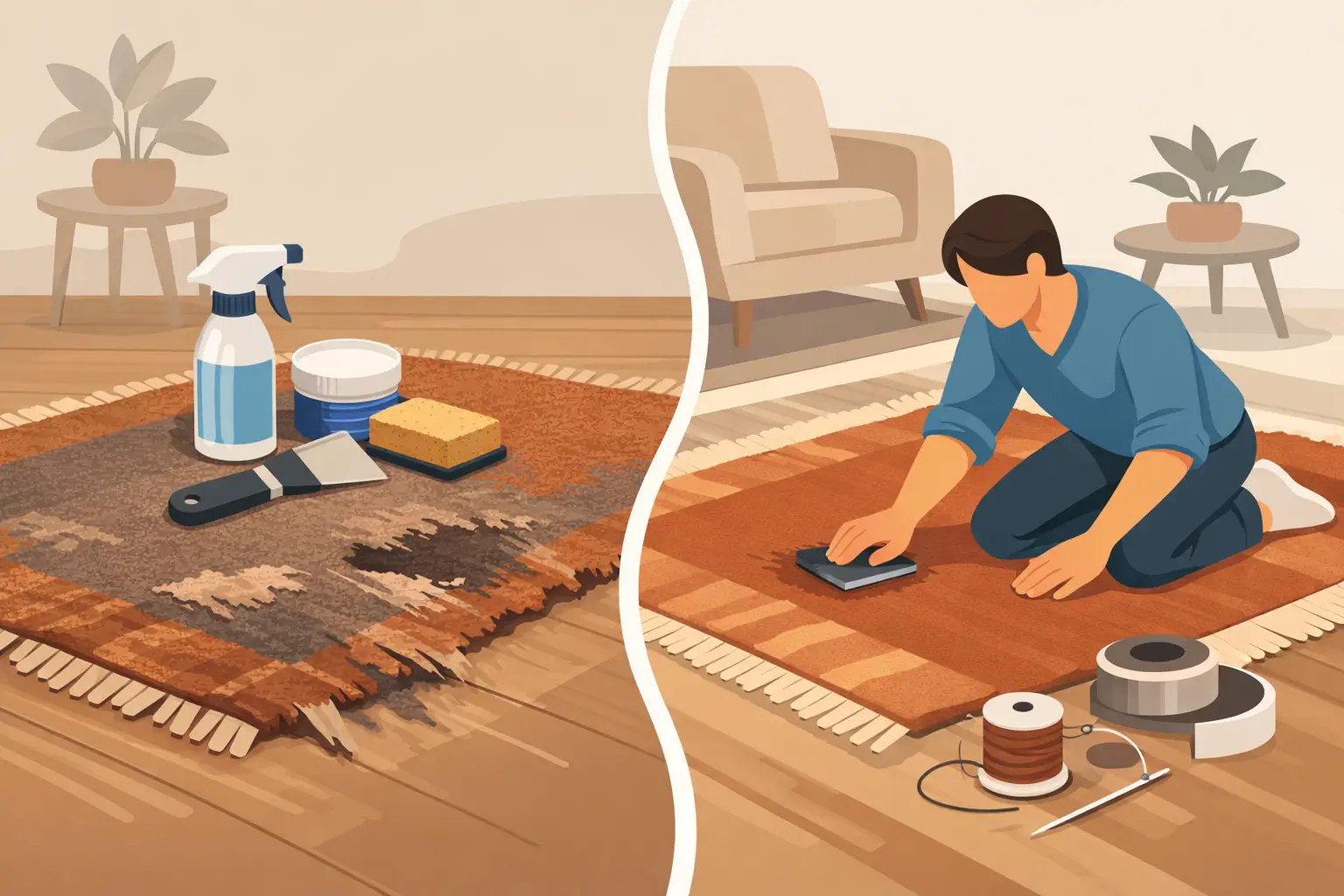
A damaged rug is not something you want to clean on impulse. That is often how the real damage begins: colours bleed, fibres break down, edges start to warp, and odours settle deep into the material. If you are wondering how to restore a damaged rug, the right first step is always to identify what kind of damage you are dealing with before choosing any method. Aggressive treatment on wool, viscose, or delicate woven rugs can cost far more than a careful, informed approach from the start. Whether you are handling rug restoration at home or considering professional help, understanding the damage is everything.
Start with a Diagnosis, not a Product
A rug can look simply dirty while actually dealing with several problems at once: worn fibres, set-in staining, moisture distortion, fraying edges, or a weakened backing. Each of these issues calls for a different approach. Jumping straight to a cleaning product before understanding the condition of the textile is one of the most common and costly mistakes homeowners make.
A recent coffee spill on a synthetic rug is a completely different situation from an old urine stain on a wool piece. The first may respond well to a targeted spot treatment. The second often requires treating the fibre, the base layer, and neutralising deep residue. This is why any serious attempt at how to restore a damaged rug must begin with a careful read of the textile’s actual condition.
Signs that something is wrong are usually straightforward: dull or faded colours, stiff patches, persistent odour, detaching fringes, flattened or missing fibres, warped surface, water marks, or embedded dust that reappears after vacuuming. The older these signs are, the smaller the margin for error becomes.
The Most Common Types of Rug Damage
Most damaged rugs fall into four main categories. The first is deep soiling, which gives the rug a grey or sticky appearance even with regular upkeep. The second is set-in staining, often made worse by repeated at-home attempts. The third covers structural damage: open seams, worn borders, or torn fringes. The fourth and most complex involves water and moisture, which can cause shrinkage, distortion, colour transfer, and lingering odour.
In family homes across Montreal, Laval, and the South Shore, rugs damaged by pets are also extremely common. The problem goes beyond appearance. Liquid can pass through the fibres, reach the backing, and dry into a layer of salts and bacteria that resurfaces every time humidity rises. A scented spray does nothing to address what is happening below the surface.
What You Can Do for Rug Restoration at Home
There are useful steps you can take on your own for rug restoration at home, as long as the goal is stabilising the damage rather than attempting a full repair. For a fresh stain, blot without rubbing using a clean white cloth, then gently dab with lukewarm water if the fibre allows it. The aim is to stop the stain from moving deeper or spreading outward into a ring.
Regular vacuuming is also essential, especially on rugs placed in high-traffic areas. It limits the mechanical wear caused by abrasive particles trapped in the fibres. That said, aggressive brushing, poorly controlled steam, or an overly wet shampooing method can weaken the structure of the rug and make rug restoration at home much harder.
If an edge is beginning to open, avoid pulling loose threads or reaching for general-purpose glue. That kind of quick fix often prevents proper repairs later. Similarly, a rug that has warped after a water incident should not be dried in direct sunlight or with intense heat. Rapid drying locks in distortion and increases the risk of shrinkage.
Mistakes That Make Rug Damage Worse
Some errors come up again and again. Excess water is the most frequent. Many homeowners assume that restoring a rug means soaking it thoroughly and scrubbing. On most fibre types, this is exactly the wrong approach. Too much moisture pushes soil toward the edges, distorts the backing, and can cause colours to bleed in ways that are difficult or impossible to reverse.
Untested stain removers are another common problem. A product that works perfectly on synthetic fabric can burn a natural fibre or leave a permanently bleached spot. Improvised acidic or alkaline home remedies are also risky. They sometimes produce a deceptively clean-looking result right away, but alter the pH of the textile and speed up ageing.
Many rugs labelled as washable also do not tolerate the same treatment depending on how they are constructed. A flat-woven piece, a tufted rug, and a latex-backed rug each have different tolerances. The word washable is not a method. Treating all three the same way is one of the most misunderstood aspects of how to restore a damaged rug properly.
When Rug Restoration at Home Doesn’t Work and it Needs a Professional
As soon as there is any doubt about the fibre type, colour stability, or structural integrity, professional treatment becomes the safest and most cost-effective path. How to restore a damaged rug is not just about removing what is visible. It is about preserving what cannot be easily replaced: pile density, weave flexibility, pattern sharpness, and border integrity.
A professional typically begins by identifying the materials and testing colour reactions. From there, the method is chosen based on the specific damage: low-moisture cleaning, controlled washing, or targeted treatment. On some pieces, the priority is removing residue without swelling the fibres. On others, the fibre needs to be rehydrated and softened before the shape can be corrected.
Textile repair then comes into the picture. A worn fringe can be consolidated or replaced. An open seam can be resewn. A rolled edge can be straightened and stabilised. A crushed area can sometimes recover its texture, provided the fibre itself has not broken down. There is a real and meaningful difference between a rug that has been recovered and one that has simply been cleaned.
At Nettoyage Imperial, the approach is never about forcing a quick result. The method is always chosen to protect the piece as durably as possible. That matters whether the rug is in a Montreal family living room, a South Shore home office, or a Laval commercial space with heavy foot traffic.
What is the first step in how to restore a damaged rug at home?
The first step is diagnosis, not cleaning. Before applying any product, identify the type of damage: soiling, staining, moisture, structural wear, or a combination. Each condition requires a different treatment. Applying the wrong method, even with good intentions, can deepen staining, distort fibres, or permanently affect colour. Understanding what you are dealing with is what separates a successful restoration from a costly mistake.
Is rug restoration at home possible for all types of rugs?
Light maintenance and fresh stain treatment can be handled at home for many rug types. However, wool, viscose, antique, hand-knotted, and latex-backed rugs all have specific tolerances that are easy to exceed without professional knowledge. If there is any uncertainty about fibre type or colour stability, a professional assessment is strongly recommended before attempting any cleaning.
How do I know if my damaged rug needs professional treatment?
If the rug has persistent odour, visible water damage, open seams, detached fringes, significant colour change, or structural distortion, it should be assessed by a professional. Attempting to fix structural damage at home often makes a proper repair harder and more expensive later on. The sooner a professional look at it, the more options are available.
Can pet damage be treated through rug restoration at home?
Surface blotting and odour neutralisers can manage very recent and minor pet incidents. However, liquid that has penetrated through the fibres into the backing requires a deep, controlled extraction process that is not achievable with household tools. Left untreated, the residue can cause persistent odour, fibre deterioration, and bacterial growth over time.
What is the difference between cleaning and restoring a rug?
Cleaning removes surface soil and staining. Restoration goes further, addressing structural damage, fibre condition, colour issues, border integrity, and long-term durability. A rug that has only been cleaned may still have underlying problems. A restored rug has been assessed, treated at multiple levels, and prepared for extended use. How to restore a damaged rug properly always involves both processes working together.
Key Takeaways
- How to restore a damaged rug always begins with a thorough diagnosis before any cleaning or product is applied.
- Rug restoration at home is appropriate for fresh stains and light maintenance, but structural and deep-moisture damage requires professional intervention.
- Excess water, untested products, and aggressive scrubbing are the most common causes of worsening rug damage during at-home attempts.
- Wool, viscose, hand-knotted, and latex-backed rugs all have unique tolerances and should never be treated with a one-size-fits-all approach.
- A professionally restored rug is assessed at multiple levels, including fibre, backing, borders, and odour, not just the surface.
- Acting early on how to restore a damaged rug preserves more options, keeps costs lower, and protects the long-term condition of the piece.