

How Much Does Duct Cleaning Cost?
A very low price can seem attractive, until the service turns out to be limited to vacuuming a few visible grilles. When you wonder how much duct cleaning costs, the right question is not only the price shown: you also need to check what the service really covers, the type of system treated, and the method used.
In Greater Montreal, Laval, the North Shore, and the South Shore, the cost varies with the layout of the building, the number of ducts, the accessibility of the equipment, and the level of buildup. A detailed quote protects the customer against unexpected fees and makes it possible to compare equivalent services.
How Much Does Residential Duct Cleaning Cost?
For a single-family home equipped with a forced-air heating system, professional ventilation duct cleaning generally falls in a range of about $250 to $500 or more. This estimate may include the main ducts, the supply and return air vents, and some accessible components of the system.
The price goes up when the home has several floors, two heating systems, many air outlets, or ducts that are hard to reach. A large property, a duplex, or a building with several units requires more time, more equipment, and an adapted procedure. In these cases, a precise assessment is preferable to a rate announced without any information about the premises.
Dryer vent cleaning is usually billed separately. Depending on the length of the run, the number of elbows, access to the exterior outlet, and the lint buildup, you should often plan on about $120 to $250. This service is distinct from central ventilation cleaning: the dryer vent requires tools and a protocol designed to remove compacted fibers and restore proper exhaust.
Servicing an air exchanger or some associated ducts can also be added to the job. The rate then depends on the unit, its condition, the number of air intakes, and the components to be cleaned. The essential point is to know, before the appointment, whether the grilles, ducts, fan, filters, accessible coils, or the air exchanger are part of the service.
What Makes the Price of Duct Cleaning Vary
Two homes of similar size do not necessarily require the same work. A recent, accessible, regularly maintained network will generally be faster to clean than an older system whose ducts have significant buildup of dust, pet hair, or renovation residue.
The number of outlets matters, but it is not the only criterion. The actual length of the network, the branches, the flexible ducts, the sections hidden in ceilings or walls, and the location of the ventilation unit directly affect the time needed. Restricted access to the basement, the roof, or an exterior dryer outlet can also change the cost.
How the premises are used matters. A home with pets, smokers, young children, or occupants sensitive to allergens may need more frequent maintenance. After construction or renovation work, fine dust can settle quickly in the system. However, you should not confuse serious preventive maintenance with an unrealistic promise to eliminate all air quality problems: ventilation, humidity, filters, and the general condition of the building also play a role.
For businesses, offices, rental buildings, restaurants, or institutional establishments, prices are generally set by quote. The volume of the network, the permitted access hours, the requirements for operational continuity, and the maintenance standards specific to the sector must be assessed. A well-planned commercial intervention limits disruption while ensuring a complete cleaning of the planned sections.
What a Professional Rate Should Include
A clear quote is not just a lump sum. It specifies the system targeted, the zones included, the limits of the service, and the possible fees. This transparency is particularly useful when very low promotional offers are presented without detail on the number of ducts covered or on possible extras.
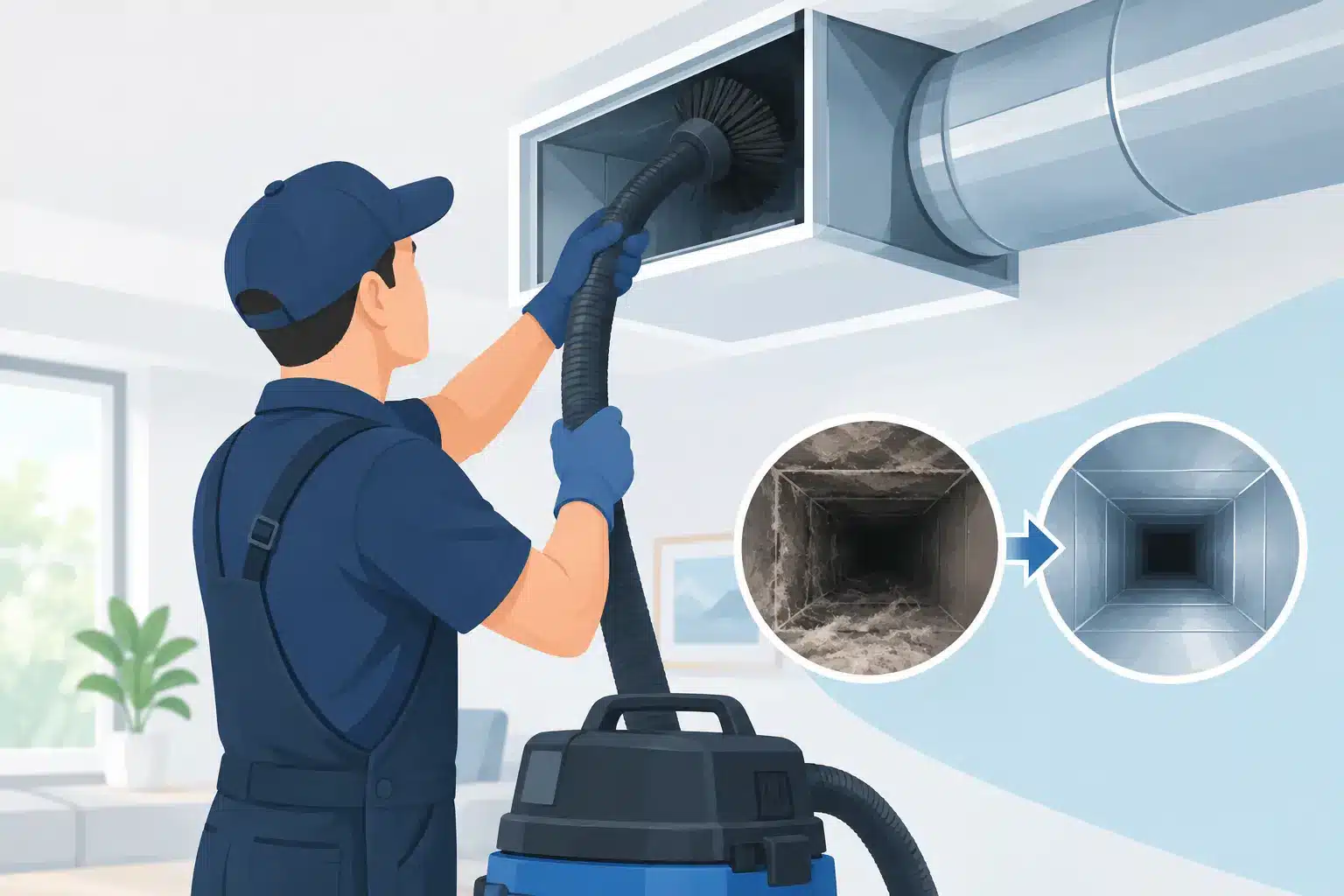
A cleaning done according to industry standards usually relies on negative pressure or powerful suction, combined with dislodging tools suited to the network. The goal is to remove accumulated particles without spreading them through the house. Technicians must also protect the work areas, inspect the useful access points, and put the components back carefully.
A credible price takes into account qualified labor, equipment, travel, and the time needed to clean the agreed network. It should not lead to high-pressure sales once the team is on site. If you are suddenly told about major work or contamination without a documented inspection and without a clear explanation, take the time to ask for details before authorizing an extra charge.
How to Get an Accurate Estimate Before the Appointment
To receive a more reliable price, prepare some simple information: the type of property, the presence of a central heating system, the approximate number of air outlets, the existence of an air exchanger, and the layout of the dryer vent. Also mention recent work, persistent odors, a decrease in airflow, or difficulty drying laundry.
Photos of the heating unit, the air exchanger, or the exterior outlet of the dryer can help define the job better. They do not always replace an on-site inspection, but they reduce areas of uncertainty. For a building or a business, indicate the number of units, the approximate dimensions, and the scheduling constraints.
Before accepting a quote, ask whether the price includes the return air ducts, the supply ducts, the grilles, and access to the main components. Also check whether dryer vent cleaning is included or is a separate service. A precise answer avoids comparing a complete cleaning with a partial intervention.
How Often Should Ducts Be Cleaned?
There is no single frequency for all buildings. For many homes, periodic maintenance every three to five years is a reasonable benchmark, to be adjusted according to how the system is used and the conditions in the household. After a major renovation, treated water damage, a move into a poorly maintained property, or the appearance of heavy visible buildup at the grilles, it may be worthwhile to act sooner.
The dryer vent deserves closer attention. If clothes take longer to dry, if the appliance becomes very hot, or if unusual odors appear, a check is recommended. A blocked exhaust reduces the dryer’s efficiency and can increase the risks linked to heat and lint buildup.
Since 1995, Nettoyage Imperial has favored a methodical approach, with certified technicians: assess the system, explain the proposed work, and use suitable equipment to achieve a clean result without compromising the installations. This approach is particularly reassuring for owners and managers who want to plan maintenance without nasty surprises.
The best investment is not necessarily the cheapest offer, but the service whose scope, method, and price are explained precisely. Well-targeted maintenance helps preserve the operation of your equipment and maintain a healthier indoor environment, season after season.
How much does duct cleaning cost for a house?
For a single-family home with forced-air heating, professional duct cleaning generally falls between about $250 and $500 or more. The price rises with several floors, two heating systems, many air outlets, or hard-to-reach ducts.
How much does dryer vent cleaning cost?
It is usually billed separately, often around $120 to $250, depending on the length of the run, the number of elbows, access to the exterior outlet, and the lint buildup.
What affects the cost of duct cleaning?
The number of outlets, the actual length of the network, flexible ducts, hidden sections, the location of the unit, restricted access, and the level of buildup all change the time needed.
What should a duct cleaning quote include?
It should specify the system targeted, the zones included, the limits of the service, and possible fees, including whether return air ducts, supply ducts, grilles, and dryer vent cleaning are covered.
How often should ducts be cleaned?
For many homes, every three to five years is a reasonable benchmark. Clean sooner after a major renovation, treated water damage, or heavy visible buildup at the grilles.
Key Takeaways
- The price shown matters less than what the service really covers, the type of system treated, and the method used.
- Residential duct cleaning for a single-family home with forced-air heating generally runs about $250 to $500 or more, and dryer vent cleaning is usually billed separately at about $120 to $250.
- The cost depends on the number and length of ducts, hidden sections, access, the location of the unit, and the level of buildup, and commercial jobs are priced by quote.
- A clear quote states the system, the zones included, the limits of the service, and possible fees, without high-pressure sales once the team is on site.
- Prepare the property type, number of air outlets, air exchanger, dryer vent layout, and recent symptoms, and ask what the price includes before comparing offers.
- For many homes, maintenance every three to five years is a reasonable benchmark, sooner after major work or water damage, and the dryer vent needs closer attention.