

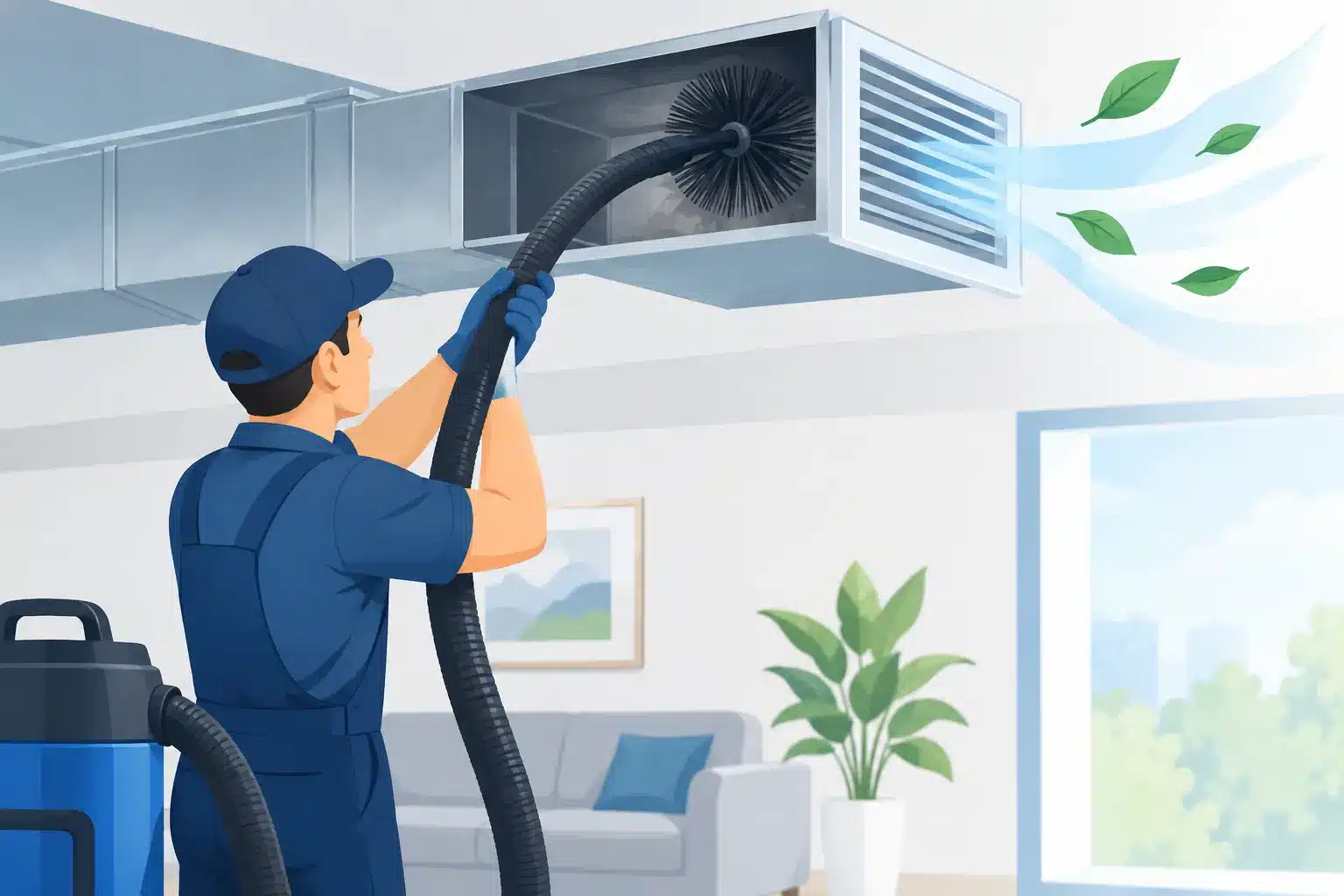
Duct Cleaning for Healthier Air
Duct cleaning, often called ventilation duct cleaning, is not just about removing a layer of visible dust near the grilles. In a house, a rental unit, or a business, the ventilation network carries the air that circulates through the rooms every day. When it accumulates dust, fibers, pet dander, construction residue, or fine particles, that buildup can contribute to odors, dirty grilles, and less pleasant indoor air quality.
In Montreal, Laval, the North Shore, and the South Shore, systems are especially in demand during the long heating and cooling periods. Suitable maintenance helps preserve the performance of the installation without promising the impossible: clean ducts do not replace good humidity control, an appropriate filter, or the correction of a mechanical problem. They are, however, part of a serious maintenance strategy for a healthier living or working environment.
Why Duct Cleaning Really Matters
Indoor air circulates in a loop in forced-air systems and in many ventilation installations. Each cycle can move the particles present in the ducts, especially when filters are poorly maintained, when animals live in the building, or when renovations have generated a lot of dust. Over time, deposits can lodge in the main ducts, branches, return air ducts, and around some accessible components.
The first benefit sought is hygiene of the network. A professional cleaning removes buildup that a household vacuum and dusting the grilles cannot reach. The second is comfort: many occupants notice fewer stuffy or dusty odors when they turn the system back on. Finally, a less loaded network helps maintain more regular airflow, particularly when the filter and the unit are maintained at the same time.
For people sensitive to allergies or irritants, it is important to be precise. Duct cleaning is not a medical treatment and cannot, on its own, eliminate all sources of allergens in a home. Carpets, upholstered furniture, mattresses, pets, humidity, and ventilation habits also play a role. It remains nonetheless a relevant measure when buildup is found in the network.
Signs That Duct Cleaning Is Justified
It is not always necessary to have ducts cleaned on a fixed schedule. The right frequency depends on how the building is used, its condition, the type of system, and the events that have occurred since the last servicing. Some signals, however, deserve a professional inspection:
- dust or debris quickly returns around the air vents;
- a persistent odor appears when the heating or air conditioning starts;
- renovation, plaster, or construction work has taken place recently;
- animals, smokers, or several occupants live in the same space;
- water damage, a moisture problem, or the presence of contaminants needs to be assessed;
- airflow seems uneven between certain rooms, after checking the grilles and filters.
A dusty duct does not automatically explain a lack of heating or cooling. Poorly positioned dampers, a clogged filter, a poorly maintained heat pump, or a failure of the unit can also be the cause. This is why a competent technician must distinguish the cleaning that is needed from a ventilation or mechanical problem that requires a different intervention.
How a Professional Duct Cleaning Works
A rigorous intervention begins with an assessment of the network, its access points, and the apparent condition of the air vents. The technician determines the appropriate method according to the type of installation, whether residential ducts, return air ducts, an air exchanger, or a more complex commercial network. This step avoids treating all systems the same way.
The cleaning usually relies on powerful, controlled suction combined with suitable agitation tools. Deposits are loosened inside the ducts while capture equipment removes them from the network. The grilles, return air ducts, and accessible sections are treated carefully to limit the return of particles into the rooms.
Protecting the premises matters as much as the power of the equipment. Access points must be properly closed again, surrounding surfaces protected, and materials handled without damaging the ducts, joints, or components of the system. A rushed intervention that is limited to vacuuming a few visible vents does not give the same result as a methodical cleaning of the entire accessible path.
You should also be wary of very low offers that state a price without specifying the number of ducts, whether return air ducts are included, additional fees, or the method used. A clear quote lets you know what will be cleaned, what will not, and whether special conditions may affect the final cost.
How Often Should Cleaning Be Planned?
For a well-maintained home, a periodic inspection is often more sensible than an automatic cleaning every year. The frequency can be shorter after renovations, a move, the arrival of a pet, a damage event, or when the system runs intensively. In a rental building, tenant turnover and work between two leases are also factors to consider.
Businesses and office buildings call for even more targeted planning. The number of occupants, operating hours, dust generated by the activity, and property management requirements influence the maintenance schedule. An office, a clinic, a retail store, and a workshop do not present the same risks of buildup or the same access constraints.
Between two services, the most useful step remains replacing or cleaning the filter according to the manufacturer’s recommendations. It is also preferable to keep the grilles unobstructed, watch for signs of moisture, and have any unusual noise or marked drop in airflow checked. These simple measures extend the effectiveness of the cleaning that was done.
Do Not Forget Dryer Vents
The dryer vent deserves separate attention. Unlike ventilation ducts, it carries hot air loaded with lint. This material builds up in the duct and can reduce exhaust to the outside. A dryer that takes longer to dry clothes, that heats abnormally, or whose exterior flap opens only slightly may signal a clogged vent.
Dryer vent cleaning helps improve drying and reduce the risks associated with lint buildup. However, you must also check the condition of the connection, the length of the run, excessive elbows, and the exterior outlet. In some cases, cleaning alone does not correct an inadequate installation or a damaged duct.
Entrusting the Work to a Qualified Team
Duct cleaning requires suitable equipment, but above all a method that respects the building and the system. An experienced team knows how to identify the necessary access points, explain the limits of the intervention, and recommend complementary maintenance when the air exchanger, the wall-mounted heat pump, or the dryer requires special attention.
Since 1995, Nettoyage Imperial has worked with owners, managers, and businesses in the Montreal area with certified technicians, structured procedures, and an approach focused on indoor air quality. The goal is simple: to provide a transparent, safe service adapted to the reality of each installation.
Before booking, take a few minutes to observe your grilles, your filter, and the behavior of your system. These details give a good starting point for the assessment and help you choose a useful intervention, at the right time, for your space.
How often should air ducts be cleaned?
There is no fixed schedule. It depends on how the building is used, its condition, the type of system, and events since the last servicing. For a well-maintained home, a periodic inspection is often more sensible than an automatic yearly cleaning.
Is duct cleaning worth it?
It removes buildup that a household vacuum cannot reach and can reduce stuffy odors. It does not replace humidity control, a suitable filter, or the correction of a mechanical problem.
How do you know if your ducts need cleaning?
Dust that returns quickly around the vents, a persistent odor when the system starts, recent renovation work, uneven airflow after checking the grilles and filters, or water damage are signs to have them inspected.
Does duct cleaning help with allergies?
It is not a medical treatment and cannot eliminate all allergen sources on its own. Carpets, upholstered furniture, mattresses, pets, and humidity also play a role.
How do you know if a dryer vent is clogged?
The dryer takes longer to dry clothes, heats abnormally, or its exterior flap opens only slightly.
Key Takeaways
- Duct cleaning removes dust, fibers, pet dander, and construction residue that a household vacuum and grille dusting cannot reach.
- Clean ducts do not replace humidity control, a suitable filter, or the repair of a mechanical problem, and they are not a medical treatment for allergies.
- The right frequency depends on the building, the system, and recent events, so a periodic inspection is often more sensible than a fixed yearly cleaning.
- A professional cleaning uses controlled suction and agitation tools, protects the premises, and treats the entire accessible path, not just a few visible vents.
- Ask for a clear quote that specifies the number of ducts, whether return air ducts are included, additional fees, and the method used.
- Replace or clean the filter as the manufacturer recommends, and do not forget the dryer vent, which carries lint and has its own warning signs.