

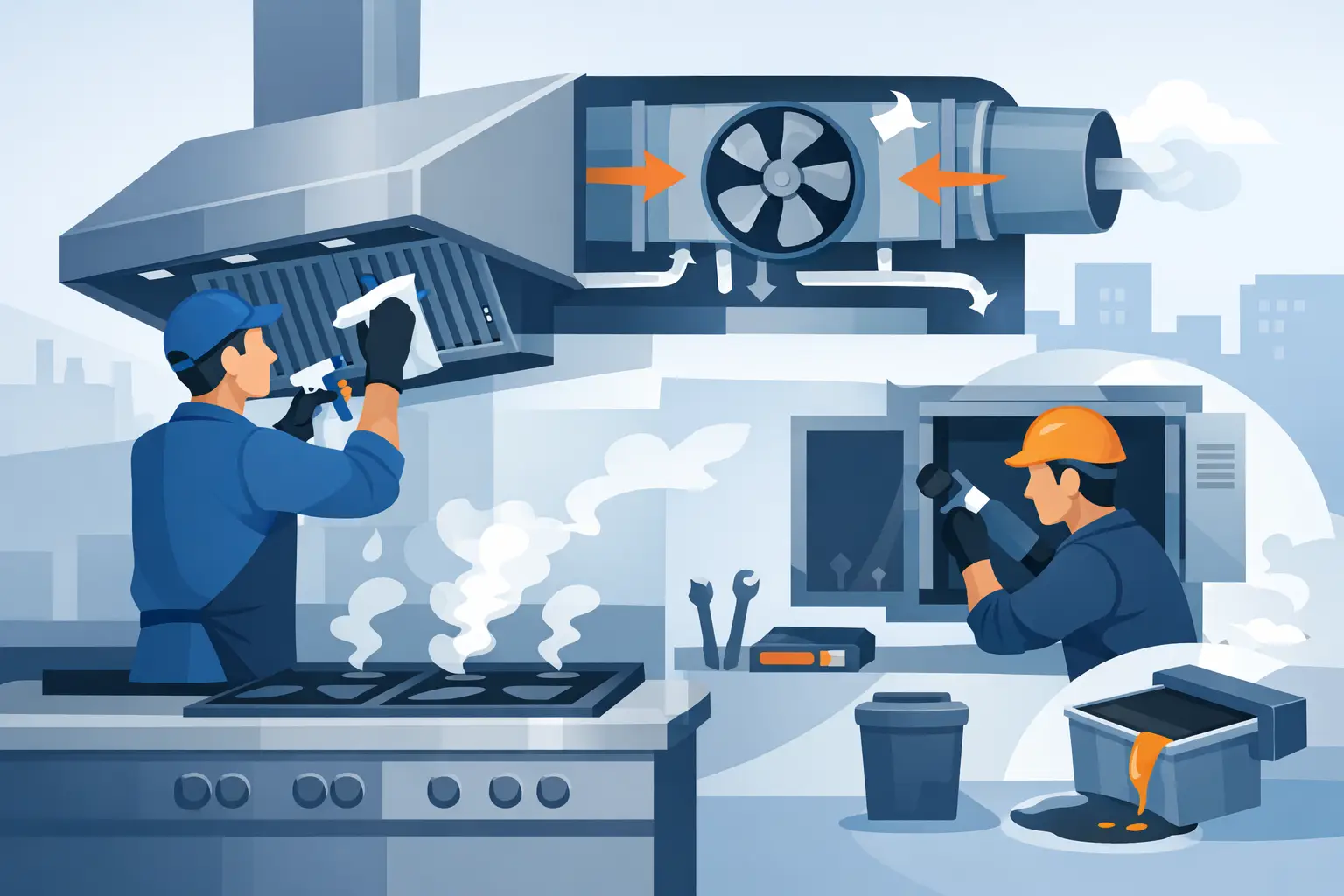
A fan that works harder than usual, a greasy smell that lingers in the dining room, filters that clog before the shift even ends. These are usually the first warning signs that your hood cleaning services aren’t keeping up with the pace of your kitchen. In a commercial kitchen, this isn’t a minor maintenance detail. It’s a direct question of safety, performance, and business continuity.
A commercial hood works under demanding conditions every single day, and without consistent kitchen hood cleaning, grease, heat, and airborne particles build up fast in the filters, ducts, and mechanical components.
Why Preventive Hood Cleaning Services Are Essential
In a restaurant, cafeteria, hotel, or institutional kitchen, the hood does more than just clear away odours. It captures airborne grease, limits heat buildup, and keeps the ventilation system balanced. When this function is only partially working, the whole kitchen environment feels the effects, which is exactly why regular hood cleaning services matter so much.
The first risk is a familiar one. Grease deposits are highly flammable, and the more they accumulate in the filters, plenum, and ductwork, the more fuel they provide for a potential fire. A reliable hood cleaning company helps keep that risk in check before it becomes a serious hazard.
The second risk is operational. A clogged system pulls air less efficiently, puts extra strain on the motor, and can make the kitchen uncomfortably hot for staff, especially during busy service periods. There’s an economic angle too. Skipping kitchen hood cleaning may feel like a short term saving, but the real costs show up quickly through breakdowns, reduced performance, early repairs, and unplanned shutdowns. In technical maintenance, prevention almost always costs less than the cleanup that follows.
What Real Preventive Maintenance Actually Covers
Many operators assume that washing the filters is enough. In reality, thorough hood cleaning services cover the entire extraction system, with a schedule that matches your kitchen’s cooking volume and activity type.
Filters are the first line of defence. They trap a large share of airborne grease, but they saturate quickly in kitchens running high heat, deep frying, or long service hours. Cleaning them regularly is essential, though it doesn’t address what builds up further inside the system.
The plenum, the interior walls of the hood, the exhaust ducts, and the fan all need regular inspection and cleaning as part of proper kitchen hood cleaning. These are the less visible areas where grease deposits become genuinely problematic. A professional hood cleaning company doesn’t just remove the grease you can see. It checks the overall condition of the components and looks for signs of wear, imbalance, or restricted airflow.
In some cases, a full assessment also includes checking belts, the motor, mounting hardware, and access to service panels. It all depends on your system’s configuration. A small counter service kitchen has very different needs than a central commissary kitchen or a facility running several high volume cooking lines.
How Often You Need Hood Cleaning Services Depends on Your Kitchen
There’s no single frequency that works for every commercial kitchen. A kitchen doing light reheating won’t build up the same residue as a restaurant running fryers, griddles, grills, and continuous cooking throughout the day. The higher the grease output, the tighter your hood cleaning services schedule needs to be.
This is where a professional assessment makes a real difference. Waiting too long between services lets risk build up unchecked. Scheduling kitchen hood cleaning more often than needed adds cost without a proportional benefit. The right rhythm depends on how intensively the kitchen is used, the types of cooking done, the system’s design, and its history of grease buildup.
Warning Signs You Shouldn’t Ignore
In practice, several signs indicate that a commercial hood is approaching a critical point. A persistent odour is often the first signal, especially when it lingers well after service ends. Reduced capture above the cooking equipment, visible grease residue, unusual mechanical noise, or excessive heat in the kitchen should all raise a flag.
It’s also worth keeping an eye on ceilings, surfaces near the cooking line, and the condition of your filters. When grease returns quickly after cleaning or filters seem saturated earlier than expected, it can point to buildup that’s already advanced inside the system. At that stage, surface level cleaning alone isn’t enough, and it’s time to call in a proper hood cleaning company.
The smart move is to act before the breakdown, before performance drops, and before it becomes an emergency. In a commercial kitchen, waiting for the worst moment is never a cost effective strategy.
In House Cleaning or a Professional Hood Cleaning Company?
Some maintenance can be handled by your own team, particularly the frequent cleaning of accessible parts when the right protocol and products are used. That’s useful, and even necessary. But it doesn’t replace full technical hood cleaning services.
The limits show up quickly. Ducts, elevated areas, mechanical components, and certain internal surfaces require safe access, proper methods, and precise knowledge of the system. Incomplete cleaning can leave hidden buildup behind. Worse, the wrong product or method can damage parts, move grease around without properly removing it, or create less stable operating conditions.
For this reason, serious operators usually rely on a simple combination: routine care handled in house for basic tasks, paired with scheduled visits from a specialized hood cleaning company for deep cleaning, inspection, and technical follow up. This approach reduces surprises and keeps a clear record of the work that’s been done.
The Real Benefits of a Methodical Approach
A well built preventive program delivers visible results from day one. Extraction stays more consistent, air circulates better, and the kitchen stays more comfortable for staff. Grease spreads less to nearby surfaces, which also makes general cleaning of the space easier through ongoing hood cleaning services.
On the equipment side, the difference is just as clear. A less clogged system runs under less strain, which can help extend the life of certain components and reduce the need for corrective repairs. No provider can promise a breakdown will never happen, but a system that receives regular kitchen hood cleaning rarely fails without warning signs first.
There’s also real peace of mind involved. For a manager, knowing that the hood, ducts, and fan are on a planned maintenance schedule makes it easier to manage risk, pass inspections, and run daily operations smoothly. That stability has real value, especially in businesses where every hour of downtime carries a direct cost.
How to Choose the Right Hood Cleaning Company
The right partner is about more than a quick visit. They should be able to assess your entire system, explain the recommended frequency, document the work performed, and follow safe, proven methods. Transparency matters just as much as execution when it comes to hood cleaning services.
It’s best to work with a company experienced in technical environments, with clear procedures and a consistent standard of work. In this field, results depend heavily on operational discipline. A serious hood cleaning company doesn’t just make the hood look cleaner. It works to reduce risk, restore system efficiency, and maintain performance over time.
For businesses in Montreal, Laval, the North Shore, and the South Shore, working with an experienced specialist like Nettoyage Imperial can make managing kitchen hood cleaning much simpler. The real value isn’t just in the cleaning itself, but in the consistency, safety, and reliable follow up behind every visit.
Prevention Beats Correction
In a commercial kitchen, hood problems rarely start with a dramatic emergency. They build up gradually, through accumulation, lost efficiency, and small warning signs that get pushed aside for lack of time. That’s exactly why preventive hood cleaning services are the smarter strategy.
A clean, well maintained system protects your equipment, your staff, and your business. And when kitchen hood cleaning is scheduled before conditions decline, your kitchen stays focused on what it does best: producing great food, not managing a problem that could have been avoided.
How often should a commercial kitchen schedule hood cleaning services?
It depends on cooking volume and equipment type. Kitchens running fryers, grills, or continuous high heat cooking need more frequent hood cleaning services than those doing light reheating. A professional assessment is the best way to set the right schedule for your specific operation.
Can my staff handle kitchen hood cleaning on their own?
Your team can manage basic tasks like cleaning accessible surfaces with the right products. However, ducts, elevated areas, and internal components require the training and equipment of a proper hood cleaning company for a thorough, safe job.
What are the warning signs that a hood needs professional attention?
Persistent odours, reduced airflow above cooking equipment, visible grease buildup, unusual fan noise, and excessive kitchen heat are all signs it’s time to book kitchen hood cleaning before a small issue becomes a bigger one.
Does hood cleaning really reduce fire risk?
Yes. Grease buildup in filters, plenums, and ducts is highly flammable. Regular hood cleaning services remove this fuel source, which is one of the most effective ways to lower fire risk in a commercial kitchen.
Why hire a specialized hood cleaning company instead of a general cleaner?
A specialized hood cleaning company understands ventilation systems, uses proper safety methods for elevated and mechanical areas, and can document the work for inspections, something general cleaning services typically can’t offer.
Key Takeaways
- Reliable hood cleaning services reduce fire risk by removing flammable grease buildup from filters, plenums, and ducts.
- A thorough kitchen hood cleaning covers the entire system, not just the filters, including the plenum, ducts, and fan.
- Cleaning frequency should match your kitchen’s cooking volume; higher grease output means a tighter schedule.
- Persistent odours, reduced airflow, and unusual fan noise are early warning signs worth acting on right away.
- In house cleaning has real limits; a professional hood cleaning company should handle deep cleaning, inspection, and technical follow up.
- Choosing an experienced hood cleaning company like Nettoyage Imperial means better documentation, consistency, and peace of mind.