

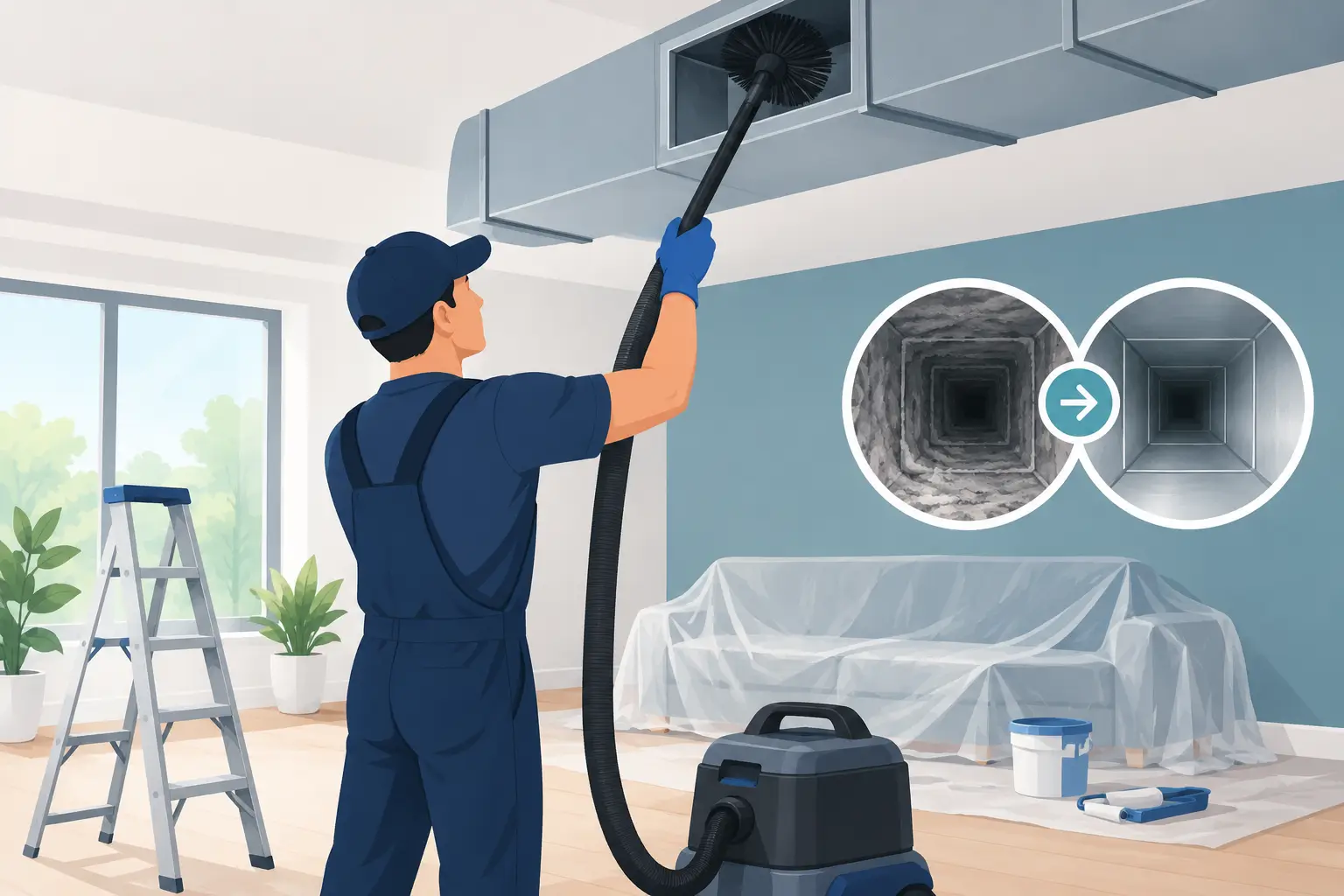
After construction work, dust does not stay only on floors, moldings, and furniture. It can also enter the ventilation system as soon as the heating, air conditioning, or air exchanger is turned back on. A case of duct cleaning after renovation must therefore be assessed methodically, particularly when the work has produced gypsum, wood, cement, or paint dust.
This step is often postponed because the ducts are out of sight. Yet a contaminated system can redistribute particles into freshly renovated rooms, harm occupants’ comfort, and speed up the buildup of dirt on some mechanical components. For owners, property managers, and businesses in Montreal, Laval, the North Shore, and the South Shore, it is a concrete measure for restoring a building to good condition after a construction project.
When Should You Clean Ducts After a Renovation?
Not every project automatically requires a full duct cleaning. The level of risk depends on the scale of the work, the nature of the materials used, the protection installed, and how the ventilation operated during the work. A small paint touch-up in a well-isolated room does not have the same consequences as a kitchen renovation, a basement demolition, or the refurbishment of several units.
Cleaning is particularly advisable if the grilles were not sealed, if the ventilation system ran during the work, or if dust is visible near the air vents. A construction odor that lingers after cleaning, a gray deposit that quickly reappears on surfaces, and a noticeable drop in airflow are also signs to consider.
Drywall work is among the most concerning. Its very fine dust circulates easily and can settle in return air ducts, main ducts, diffusers, and filters. Wood sanding, ceramic cutting, concrete work, and demolition can cause the same problem, with particles of different sizes and densities.
A Switched-Off Ventilation System Does Not Guarantee Clean Ducts
It is better to turn off the system during a dusty project, but this precaution does not replace an inspection. Unprotected openings remain exposed to air movement, drafts created by doors, and dust raised by workers. In addition, when the system restarts, the particles around the grilles can be pulled into the network.
This is why a professional assessment does not rely only on the apparent condition of the air vents. It takes into account the type of work, the condition of the filter, the presence of debris in the accessible ducts, and the maintenance history of the system.
The Risks of a Contaminated Ventilation System
After a renovation, the main consequence is the recirculation of dust in the indoor air. This dust can contain gypsum, fibers, wood residue, sand, plaster particles, or other contaminants related to the construction site. It can bother sensitive people, especially those who live with allergies, asthma, or respiratory irritation.
The problem is not only about health and comfort. Dust buildup can also reduce filtration efficiency and soil heating, air conditioning, or air recovery components more quickly. A clogged filter forces the system to work harder. In some cases, airflow becomes uneven between rooms, which affects comfort and can make temperature control more difficult.
In rental buildings and commercial spaces, the issue is even broader. Work carried out in one unit can affect neighboring occupants if the networks are connected or if dust has circulated through common areas. A cleaning planned for the end of the project helps deliver a cleaner and more professional space.
How Does a Professional Cleaning Work?
An effective duct cleaning is not a matter of quickly vacuuming the grilles. The quality of the result depends on the ability to dislodge deposits and extract them without spreading them through the building. The procedure begins with an inspection of the network, the available access points, and the connected equipment, such as return air ducts, diffusers, the air exchanger, or the dryer vent when it is affected by the work.
Technicians first protect the work areas. They then use suitable suction equipment to create negative pressure in the network, which captures the dislodged particles instead of letting them return to the rooms. Mechanical tools and appropriate brushes are used to dislodge deposits on the duct walls.
The grilles, return air ducts, and accessible components are carefully cleaned. The filter must be checked and replaced if needed, because a filter that has been through the renovation period may already be heavily loaded. Depending on the installation, servicing the air exchanger or certain heat pump components may also be recommended, without confusing these services with the cleaning of the central network.
Why Home Solutions Have Their Limits
Vacuuming around the grilles is useful for routine upkeep, but this method does not reach the deep sections of the network. Household attachments have limited reach and generally do not create the suction needed to recover dust that has been dislodged farther into the ducts.
You should also avoid introducing chemicals or water into a duct without a diagnosis. Some materials, insulation, or mechanical components require a precise approach. A poor intervention can move contaminants, damage part of the system, or create an unnecessary moisture problem.
The Right Time to Plan the Work
Duct cleaning should ideally take place after the dusty work and before the final occupancy of the premises. It is best to finish the demolition, drywall, sanding, cutting, and construction site cleanup before the intervention. If work continues after the cleaning, the ducts risk being contaminated again.
In a phased renovation, it may be wise to plan a first targeted intervention if the system has been exposed, followed by a final cleaning once the project is completely finished. This decision depends on the duration of the work, the renovated areas, and whether or not the building remains occupied.
To limit buildup during the project, contractors and occupants should seal the grilles in work areas, use temporary partitions when possible, clean surfaces regularly, and replace filters according to the intensity of the work. These precautions reduce the risk, but they do not replace cleaning when contamination is already present.
Choosing a Company That Inspects Before Acting
A good provider does not promise the same service to every building. They explain what will be cleaned, how the ducts will be accessed, what equipment will be used, and what limits may apply depending on the layout of the network. A clear quote should specify the scope of the work rather than relying on a vague price or a rushed intervention.
Technical experience also matters. Residential ducts, commercial networks, air exchangers, and dryer vents are not all treated the same way. Trained technicians can adapt their methods to the materials, protect renovated surfaces, and work without compromising the equipment.
Since 1995, Nettoyage Imperial has supported owners and property managers across the Greater Montreal area with a structured approach, certified technicians, and equipment designed for deep cleaning. After a construction project, this rigor makes it possible to treat the ventilation system as an essential part of restoring the building, and not as a secondary detail.
A successful renovation is recognized as much by what you see as by what you breathe. When construction dust has been able to reach the ventilation, planning an inspection and a suitable cleaning lets you truly enjoy the improvements made to your space.
Do you need to clean air ducts after a renovation?
Not always. It depends on the scale of the work, the materials, the protection installed, and whether the ventilation ran. Cleaning is advisable if the grilles were not sealed or dust is visible near the air vents.
How do you know if your ducts are dirty after a renovation?
Look for visible dust near the air vents, a construction odor that lingers after cleaning, a gray deposit that quickly reappears, and a drop in airflow.
Can you use a household vacuum to clean air ducts?
It helps with routine upkeep around the grilles, but it does not reach the deep sections of the network or create enough suction to recover dislodged dust.
What happens if you do not clean air ducts after a renovation?
Dust keeps recirculating in the indoor air, which can bother people with allergies or asthma, reduce filtration efficiency, and make airflow uneven between rooms.
When is the best time to clean ducts after a renovation?
After the dusty work and before final occupancy. If work continues afterward, the ducts risk being contaminated again.
Key Takeaways
- Not every renovation requires a full duct cleaning. The need depends on the scale of the work, the materials, the protection installed, and how the ventilation operated during the project.
- Unsealed grilles, a system that ran during the work, visible dust near the air vents, a lingering construction odor, a gray deposit that reappears quickly, and reduced airflow are signs to consider.
- Turning off the system during a dusty project is preferable, but it does not replace an inspection of the ducts.
- A contaminated network recirculates dust in the indoor air, can bother people with allergies or asthma, reduces filtration efficiency, soils components more quickly, and can make airflow uneven between rooms.
- A professional cleaning uses negative pressure and mechanical tools to extract deposits without spreading them, while vacuuming around the grilles and adding chemicals or water do not reach or safely treat the deep sections of the network.
- The best time to clean is after the dusty work and before final occupancy. Sealing grilles, using temporary partitions, and replacing filters reduce the risk but do not replace cleaning when contamination is already present.
- Choose a provider who inspects before acting and clearly specifies the scope of the work, the access points, the equipment, and the limits of the intervention.