

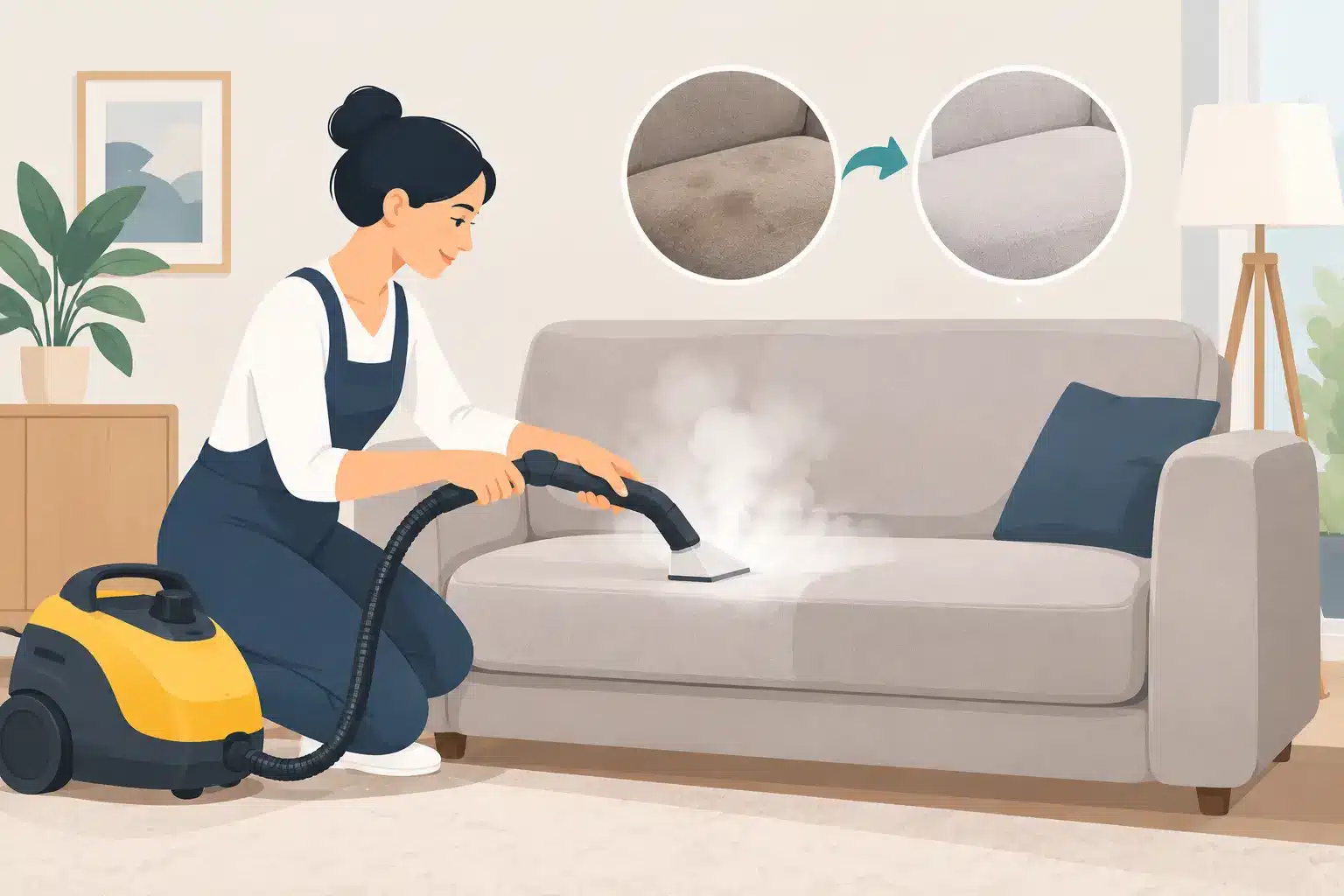
Couch Steam Test: Avoiding Unpleasant Surprises
A ring that spreads, a color that bleeds, or a fabric that turns rough: these are the risks a couch steam test makes it possible to avoid before any intervention. Steam can be very effective on certain fibers and certain types of dirt, but it is not automatically suitable for every upholstery. For a couch, the cleaning method must always follow the material, its condition, and the type of stain.
In Montreal, Laval, the North Shore, and the South Shore, couches are often subjected to heavy use: children, pets, meals, heating in winter, humidity in summer, and urban dust. A serious diagnosis before cleaning therefore makes all the difference between a clean result and damage that is hard to correct.
Why Do a Couch Steam Test?
The test consists of applying the planned method to a barely visible area of the couch, for example under a cushion, at the back of the piece, or near the zipper of a cover. It makes it possible to observe how the fabric reacts to heat, to moisture, and, if needed, to the cleaning product used.
This preliminary check verifies several things. The technician first observes color stability: some textiles can bleed, fade, or create water marks. They also check whether the fibers shrink, distort, or become stiffer. Finally, they make sure the fabric dries evenly, with no ring or visible wicking of residue.
The test is particularly relevant for delicate fabrics, older couches, dark or very bright colors, natural fibers, and furniture whose care label is missing or incomplete. A sturdy appearance does not guarantee that an upholstery will tolerate steam. Two couches that look similar can have very different compositions, dyes, and padding.
Steam, Injection-Extraction, or Dry Cleaning: The Right Method Depends on the Fabric
The term “steam cleaning” is often used to describe several processes. However, dry steam at high temperature and injection-extraction cleaning do not have the same effect on a couch.
Steam uses little water but involves significant heat. It can help sanitize some surfaces and loosen light dirt, provided the textile tolerates it. Used poorly, it can set certain stains, alter an adhesive, make a dye migrate, or reach the padding excessively.
Injection-extraction applies a controlled cleaning solution, then recovers it immediately with powerful equipment. This method is often appropriate for fabrics that tolerate water-based cleaning and that have embedded dirt, odors, or food stains. Its effectiveness, however, depends on the amount of moisture applied, the rinsing, the suction, and the drying time.
For some fragile fabrics, such as velvet, silk, certain natural fibers, or upholstery with unstable colors, a low-moisture method or a specialized cleaning may be preferable. Leather also requires a distinct treatment: steam or intensive extraction risk removing its protective oils and changing its finish.
The test therefore does not serve only to confirm that the couch can be cleaned. It serves to determine how to clean it without compromising its appearance or durability.
What a Professional Checks Before Applying Steam
Before the test, the inspection starts with identifying the upholstery. The manufacturer’s label may contain a useful care code: W for water-based cleaning, S for solvents, WS for both methods, and X for vacuuming or professional brushing only. These indications are valuable, but they do not replace a real examination of the furniture. The age of the couch, previous repairs, fiber wear, and stain-protection treatments already applied can change how the fabric reacts.
The technician also examines the stained areas. A coffee, wine, urine, grease, or makeup stain is not treated the same way. Heat can sometimes complicate the removal of a protein or sugar stain if it is applied too early. A persistent odor may come from the inner padding and call for a targeted treatment rather than a simple pass of steam on the surface.
The padding is another determining factor. If too much moisture penetrates under the fabric, drying can be slowed and create a stale odor. In a poorly ventilated home or during a humid period, the method must be adjusted and adequate air circulation recommended after the service.
Signs of a Successful Test
A test is considered satisfactory when the color remains stable, the fabric keeps its texture, and the area dries without a visible line. The professional also checks that no color transfers onto a white towel and watches how the fabric reacts during drying.
Even when a first test is successful, the intensity of the cleaning can still be adapted. The temperature, the pressure, the product used, and the moisture level must stay proportionate to the condition of the couch. A more aggressive cleaning is not necessarily a more effective one.
The Limits of Testing at Home
Testing a small area yourself is preferable to treating the whole couch without precautions. However, a home trial does not always reproduce the conditions of a complete cleaning. A household machine can leave more moisture, steam that is too hot can be concentrated in the same spot, and a store-bought product can react with an old textile protection.
Universal stain removers are another source of problems. Some leave a sticky film that quickly attracts dust. Others contain bleaching agents or solvents that change the color. Rubbing a stain vigorously can also wear down the fibers, spread the dirt, and create a visibly paler area.
If you want to do a limited trial, choose a hidden area, use only a very small amount of product, and let it dry completely before judging the result. Do not go ahead with the full cleaning if the fabric bleeds, becomes stiff, buckles, or shows a ring. These signs indicate that another method should be preferred.
When Steam Can Be a Bad Idea
Steam is not recommended when the label prohibits water-based cleaning or when the fabric shows obvious instability. It also calls for particular caution on upholstery containing silk, viscose, unstabilized linen, certain velvets, leather, or faux leather that is sensitive to heat.
Tufted couches, models with buttons, non-removable cushions, and older furniture can also trap moisture in areas that are hard to dry. In these cases, the priority is to clean deeply while keeping the moisture level under control.
You must also distinguish a recent stain from an old one. A fresh stain may need quick absorption and a precise pretreatment. A stain that is already set may require several steps, with no guarantee of complete removal if it has altered the fiber or the dye. A serious company explains this limit before the intervention rather than promising an unrealistic result.
Safe Couch Cleaning Starts with a Diagnosis
The couch steam test is part of a broader professional procedure: inspection, identification of the textile, stability test, stain treatment, suitable cleaning, extraction or moisture control, then a final check. This approach protects the furniture while aiming to remove dust, allergens, odors, and accumulated dirt.
Since 1995, Nettoyage Imperial has favored this methodical assessment for upholstered furniture. The choice of equipment and products should never be dictated by a single technique, but by what your couch can really withstand.
Before entrusting a couch to steam or pulling out a rental machine, look at it as an assembly of fibers, dyes, and padding, not just a stained surface. This discreet precaution can preserve its comfort, its color, and its value for many years.
What is a couch steam test?
It consists of applying the planned method to a barely visible area, such as under a cushion or at the back of the piece, to observe how the fabric reacts to heat, moisture, and the cleaning product.
What do the cleaning codes W, S, WS, and X mean on a couch?
W is for water-based cleaning, S is for solvents, WS is for both methods, and X is for vacuuming or professional brushing only. They are valuable but do not replace a real examination of the furniture.
Which couch fabrics should not be steam cleaned?
Steam calls for particular caution on silk, viscose, unstabilized linen, certain velvets, leather, and faux leather sensitive to heat. It is also not recommended when the label prohibits water-based cleaning.
Can you test a couch for steam cleaning yourself?
Yes, on a hidden area, with a very small amount of product, letting it dry completely before judging. If the fabric bleeds, becomes stiff, buckles, or shows a ring, do not proceed with the full cleaning.
Can you steam clean a leather couch?
Leather requires a distinct treatment. Steam or intensive extraction risk removing its protective oils and changing its finish.
Key Takeaways
- A couch steam test applies the planned method to a hidden area to check color stability, shrinkage or stiffness, and even drying before cleaning the whole piece.
- Steam, injection-extraction, and dry cleaning do not have the same effect, so the method must follow the fabric, its condition, and the type of stain.
- The care label code (W, S, WS, X) is useful but does not replace a real examination of the couch.
- Delicate fabrics, silk, viscose, certain velvets, and leather call for a low-moisture or specialized approach, and leather needs a distinct treatment.
- A home test is better than no test, but it does not always reproduce a full cleaning, and a bleeding, stiff, buckled, or ringed fabric means another method should be used.
- Safe cleaning follows a procedure: inspection, textile identification, stability test, stain treatment, suitable cleaning, moisture control, and a final check.