

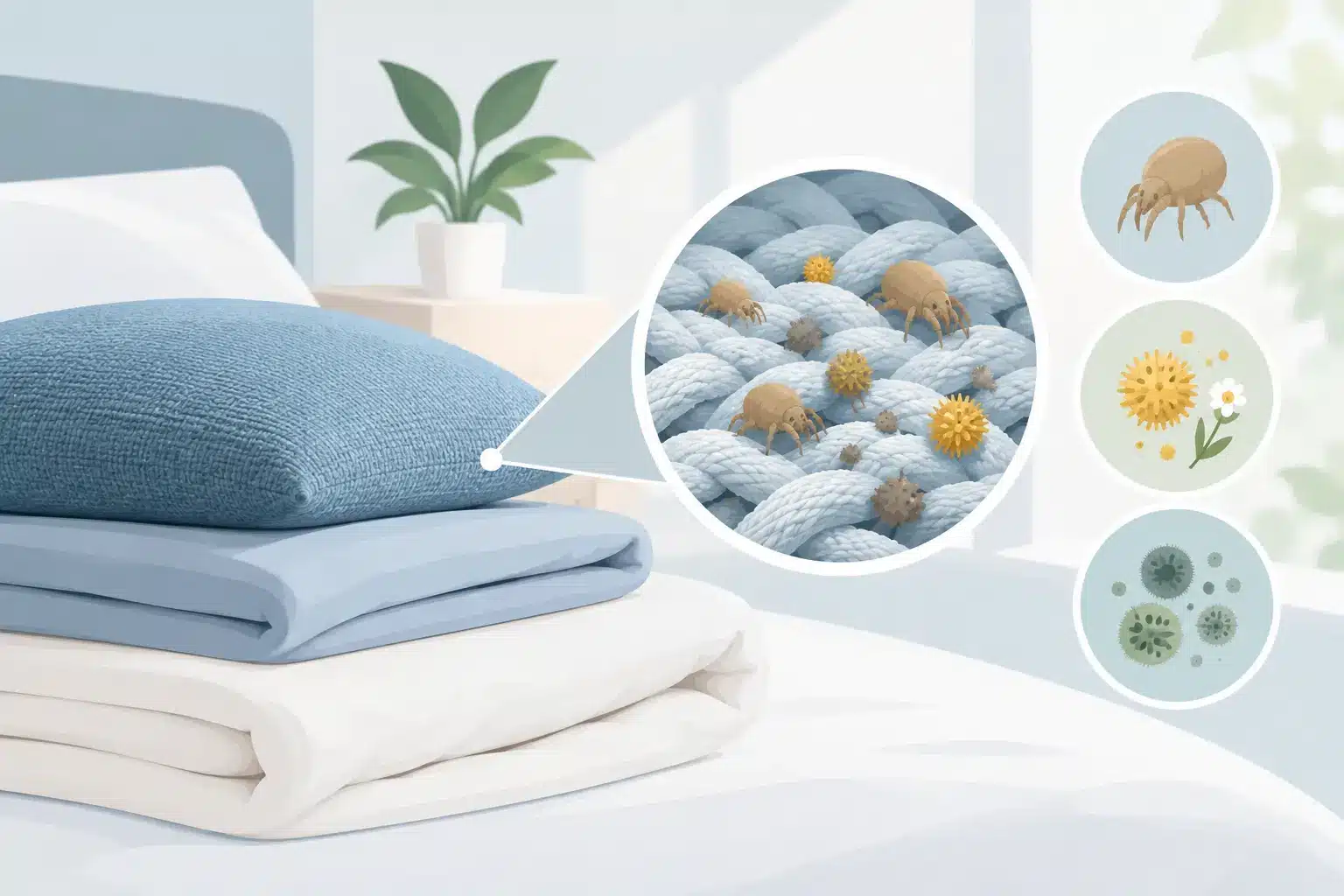
Do Textiles Hold Allergens?
A rug that looks clean, a stain-free sofa, and well-hung curtains can still shelter invisible particles. Do textiles hold allergens? Yes, often in significant amounts, especially when they are thick, heavily used, or poorly maintained. For sensitive people, this buildup can contribute to breathing discomfort, sneezing, irritated eyes, or a feeling that the air in the house is less healthy.
Carpets, upholstered furniture, mattresses, cushions, and curtains do not produce allergens themselves. They act instead as passive filters: their fibers capture and keep what circulates in the air or is carried in under shoes, on clothing, and by pets. Regular maintenance suited to the material helps limit this load without damaging the surfaces.
Which Allergens Build Up in Textiles?
The term “allergens” covers different particles that can trigger or worsen reactions in some people. In a home or a commercial space, the most common are dust mite debris and droppings, pet dander, pollen, mold spores, and certain dust particles.
Dust mites find favorable conditions in fabrics that retain heat, moisture, and organic matter, notably mattresses, box springs, small rugs, and upholstered furniture. They are not visible to the naked eye, and the problem is not limited to dust on the surface. Their allergens can penetrate between the fibers and build up in the padding.
Pet hair is generally easy to notice. Dander is much less so. These tiny fragments of skin can cling to fibers, circulate with dust, and settle on armchairs, cushions, rugs, and blankets. Pollen, particularly present in spring and late summer in Quebec, also comes in through windows, shoes, and clothing.
Why Some Fabrics Hold More Allergens
The ability to retain particles depends first on the structure of the textile. A long-pile rug, a textured fabric sofa, or a thick mattress offers more places for particles to lodge than a hard, smooth surface. The tighter, deeper, or more static-charged the fibers are, the harder it becomes to remove all the dust with a simple pass of the vacuum.
Use also has a direct effect. In an entrance, a busy living room, or a waiting room, rugs continually receive particles from outside. In a bedroom, the mattress and bedding naturally accumulate skin cells, body moisture, and dust over the nights.
Indoor humidity is another factor to watch. An environment that is too humid favors dust mites and can create conditions suited to mold growth in some textiles or under a rug. Conversely, excessively dry air can lift dust more easily. The right balance depends on the building, its ventilation, and the season.
The Limited Role of the Household Vacuum
Vacuuming remains essential, but its effectiveness varies with the appliance, the filter used, and the method. Slow vacuuming with a suitable brush removes a significant part of the surface debris. However, it does not always dislodge particles deeply embedded in the fibers, nor those held in the padding of a sofa or a mattress.
A poorly maintained appliance can also put some of the fine particles back into the air. Bags, filters, and brushes should therefore be checked regularly. For households affected by allergies, a vacuum with high-performance filtration is a sensible choice, but it does not replace a deep cleaning when textiles are heavily loaded.
Reducing Allergens Without Damaging Your Textiles
The best approach relies on regularity and on suitable methods. It is not enough to mask odors with a fabric fragrance or to scrub a stain vigorously. Some household products leave residues that then attract dirt, while too much water can prolong drying and increase moisture-related risks.
For rugs and carpets, methodical vacuuming once or twice a week is a reasonable baseline in areas used daily. Entrances, spaces occupied by pets, and children’s rooms often need more frequent attention. It is helpful to occasionally move small pieces of furniture to remove what accumulates in hard-to-reach areas.
Bedding should be washed regularly according to the manufacturer’s instructions. Protective covers designed for mattresses and pillows can also limit contact with dust mite allergens. They do not replace mattress cleaning, but they are a useful layer of prevention, particularly for allergic people.
Curtains, decorative cushions, and throws are often forgotten. Check their labels: some can be washed, while others require specialized treatment. A delicate textile, velvet, a fabric with a lining, or dense padding should not be treated at random with a stain remover or a steam machine.
When Professional Cleaning Becomes Relevant
Professional cleaning is indicated when the rug looks dull despite vacuuming, when an odor persists, when pets live in the space, or when allergy symptoms seem more present indoors. It is also recommended after minor damage, a moisture episode, dust-generating work, or a move.
The value of a professional intervention is not only in the power of the equipment. It rests on diagnosing the material, choosing a safe method, controlling moisture, and effectively extracting dirt and residue. A wool rug, an antique rug, a microfiber sofa, and a mattress are not treated in the same way.
For rugs and upholstered furniture, extraction cleaning can remove particles lodged beneath the surface when the method is applied correctly. The amount of water, the cleaning solution, the contact time, and the drying must be controlled precisely. A poor process can cause overwetting, rings, shrinkage, or premature wear of the fibers.
At Nettoyage Imperial, interventions are planned according to the type of textile, its condition, and how heavily the premises are used. This approach helps achieve a deep cleaning while respecting the materials and limiting drying time. In buildings, offices, and businesses, it also makes it possible to coordinate the service with occupancy constraints.
Do Not Forget the Air and Sources of Dust
A clean textile cannot make up for a continuous source of dust in the building. If the ventilation ducts are loaded, if the filters are neglected, or if the air exchanger is not working well, particles can come back and settle on rugs and furniture. Renovation work, windows frequently opened during pollen periods, and pets also influence how quickly buildup occurs.
An effective strategy is to combine textile maintenance with good management of indoor air. Maintain reasonable humidity, service ventilation systems according to the applicable recommendations, and use door mats to reduce the dirt brought in from outside. In high-traffic areas, preventive maintenance generally costs less than restoration after heavy soiling.
Allergies do not always disappear after cleaning a rug or a sofa, because their causes are multiple and specific to each person. However, reducing the amount of particles held in textile surfaces lowers an avoidable source of exposure. For a household, a rental unit, or a workspace, it is a concrete measure that protects air quality, everyday comfort, and the lifespan of textiles.
Do textiles hold allergens?
Yes, often in significant amounts, especially when they are thick, heavily used, or poorly maintained. They do not produce allergens themselves, but their fibers act as passive filters that capture and keep particles.
What allergens build up in carpets and upholstery?
The most common are dust mite debris and droppings, pet dander, pollen, mold spores, and certain dust particles.
How often should you vacuum to reduce allergens?
Once or twice a week is a reasonable baseline for rugs and carpets in areas used daily. Entrances, spaces occupied by pets, and children’s rooms often need more frequent attention.
Does vacuuming remove allergens from carpets and sofas?
It removes a significant part of the surface debris, but it does not always dislodge particles deeply embedded in the fibers or held in the padding of a sofa or a mattress. A vacuum with high-performance filtration is a sensible choice for allergy households.
When should textiles be professionally cleaned for allergens?
When a rug looks dull despite vacuuming, an odor persists, pets live in the space, or allergy symptoms seem more present indoors. It is also recommended after minor damage, a moisture episode, dusty work, or a move.
Key Takeaways
- Textiles do not produce allergens, but their fibers act as passive filters that capture and keep dust mite debris, pet dander, pollen, mold spores, and dust.
- Thick, long-pile, heavily used, or poorly maintained textiles hold more, and indoor humidity affects dust mites and mold.
- Vacuuming is essential but does not always reach particles deep in the fibers or padding, so use a vacuum with good filtration and check bags, filters, and brushes.
- Vacuum daily-use rugs once or twice a week, wash bedding regularly, use protective covers for mattresses and pillows, and check care labels on curtains, cushions, and throws.
- Professional extraction cleaning suits dull rugs, persistent odors, pets, and indoor allergy symptoms, but the method, water amount, and drying must be controlled to avoid damage.
- Also address ventilation ducts, filters, the air exchanger, humidity, and door mats, since clean textiles cannot make up for a continuous source of dust.