

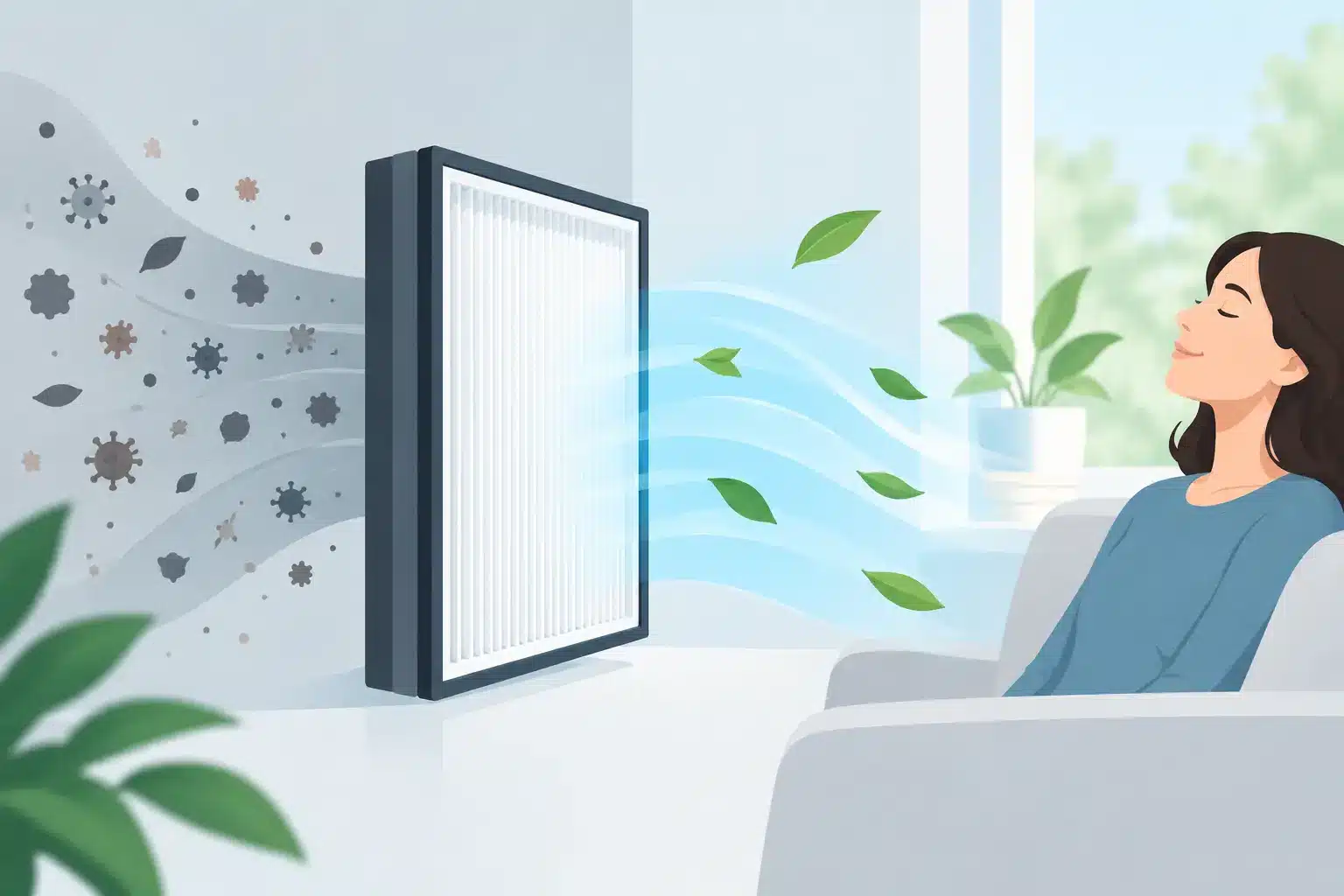
When a child sneezes waking up, when a dusty smell returns after cleaning, or when allergies seem worse indoors than outdoors, HEPA filters naturally come to mind. They can genuinely improve particle capture in a vacuum cleaner or an air purifier, but only if they suit the appliance, are properly installed and are maintained according to the manufacturer’s recommendations.
A high-performing filter does not replace surface cleaning, ventilation maintenance, or humidity control. It acts instead as an additional barrier against airborne particles. For homeowners, families, property managers and businesses in Montreal, Laval, the North Shore and the South Shore, understanding this distinction makes it possible to make a useful choice rather than relying only on a label.
What Do HEPA Filters Really Capture?
What “HEPA” Means
HEPA stands for High Efficiency to Particulate Air. This designation refers to filters designed to capture a very large proportion of fine particles. According to the commonly cited American standard, a true HEPA filter captures at least 99.97% of 0.3-micrometer particles under specific test conditions. In Europe, classifications may instead refer to the EPA, HEPA, and ULPA categories, such as E10 to E12 or H13 and H14.
Why the 0.3 Micrometer Figure Is Often Misunderstood
The 0.3-micrometer figure is often misinterpreted. It does not mean the filter let’s all smaller particles through. This size corresponds to the most demanding filtration point for several physical mechanisms. Larger particles are intercepted more easily, while some very fine particles can be captured by diffusion within the fibers of the filter medium.
What a HEPA Filter Can Do at Home
In a household setting, a good HEPA filter can help capture fine dust, pollen, pet dander, mold spores, some dust mite residues, and some of the particles associated with smoke. Its effectiveness depends, however, on airflow, the airtightness of the housing, and the condition of the filter. A punctured or poorly positioned HEPA medium, or one installed in an appliance that leaks along the sides, loses much of its value.
Vacuum Cleaner, Air Purifier or Central System: Using HEPA Correctly
The word HEPA appears on many products, but the role of the filter changes depending on the equipment. A HEPA filter in a vacuum cleaner mainly prevents the particles that have been vacuumed from returning to the room through the appliance exhaust. In an air purifier, it treats the air that circulates continuously in a defined area. In a heating, air conditioning, or ventilation system, adding a denser filter should be evaluated carefully.
In a Vacuum Cleaner: Sealing Matters as Much as the Filter
A vacuum cleaner with a HEPA filter is particularly relevant in a home where people with allergies, young children, or pets live. You should nevertheless check that the appliance has a sealed system. Without effective gaskets, some of the dust-laden air can bypass the filter and be released back into the room.
Carpets, area rugs, upholstered furniture and mattresses hold many particles over the months. Vacuuming reduces surface buildup, but it does not always extract the dirt embedded in the fibers or sticky residues. Periodic professional cleaning therefore complements the filtration of work, especially in high-traffic areas or after a heating season when windows are rarely opened.
In an Air Purifier: The Capacity of the Unit Is Decisive
A purifier equipped with a HEPA filter cannot be judged solely by the presence of the filter. Its capacity must match the surface area of the room and the volume of air to be treated. A small unit in a large open space will filter the air, but too slowly to produce the expected result.
It is also preferable to use it in a room where doors and windows remain reasonably closed while it is running. In a bedroom, it can be useful to run it for several hours before bedtime and throughout the night, in a setting compatible with noise comfort. In a common area, a unit that is too noisy is likely to be switched off frequently, which reduces its real-world effectiveness.
In Central Ventilation: Beware of Air Resistance
Installing a very dense filter in a central system is not automatically an improvement. A HEPA filter generally creates higher air resistance than a standard filter. If the fan, the filter housing or the ducts were not designed for this constraint, airflow may decrease. The system may then work harder, heat up unnecessarily, or distribute air less effectively in some rooms.
Before changing the filter type in your air exchanger, central system or heat pump, consult the equipment specifications. In some cases, a quality filter compatible with the system, replaced at the right time, gives a better result than a very restrictive filter that is poorly suited. Maintenance of the ducts and mechanical components also remains essential when dust, odors or debris build up.
How to Recognize a Quality Filter
The mentions “HEPA-type,” “HEPA-like” or “HEPA-style” do not necessarily guarantee the same level of performance as a certified HEPA filter. They sometimes describe a material resembling a HEPA medium, without specifying the capture rate or the test method. It is better to look for a clear indication of the standard or classification used, as well as the exact compatibility with the appliance.
Also check the dimensions, the direction of installation, and the presence of a gasket that fits the frame properly. A filter that is slightly too small lets air pass around it. In an air purifier, the price and availability of replacement filters are also worth considering before purchasing. An affordable appliance becomes less attractive if its filters are hard to find or excessively expensive.
Odors and Gases: HEPA Alone Is Not Enough
For odors, volatile organic compounds, and certain gases, HEPA alone is not enough. It captures particles, not gas molecules. An activated carbon layer can help reduce some odors, but its capacity is limited, and it wears over time. A persistent odor often requires identifying its source: humidity, a contaminated carpet, dirty ducts, smoke, cooking, or a mechanical problem.
Maintenance: Habits That Protect Efficiency
A HEPA filter should not be cleaned at random. Some models are washable, but many HEPA filters are not. Rinsing them, brushing them aggressively or blowing them with compressed air can damage the fibers and reduce their filtration capacity. The manufacturer’s instructions always take priority.
The pre-filter, when present, catches hair, textile fibers and larger dust. Regular maintenance of it extends the life of the main filter. When replacement is necessary, avoid shaking the used filter inside the home. Place it gently in a closed bag, especially if people sensitive to allergies or asthma occupy the premises.
A saturated filter can still capture particles, but it gradually reduces airflow. In a vacuum cleaner, you will notice a loss of suction. In a purifier, the unit may become noisier or less effective. Following the recommended replacement interval is more reliable than waiting for a filter to look completely black.
Filtration Does Not Fix a Source of Contamination
HEPA filters are effective against airborne particles, but they do not on their own solve a humidity problem, a water leak, active mold or a significant accumulation of dust in textiles and ducts. They do not disinfect a surface and do not make allergens already deposited in a carpet, sofa or mattress disappear.
Better indoor air quality relies on several complementary measures: vacuuming with a well-filtered appliance, cleaning surfaces regularly, controlling humidity, maintaining ventilation equipment and having textiles deeply treated when necessary. For homes and commercial premises, Nettoyage Impérial can assess visible sources of buildup and suggest a safe method for the carpets, furniture or ducts concerned.
A well-chosen HEPA filter can support a cleaner environment, but its value is measured mostly within the whole of your maintenance habits. When the air feels heavy, when dust returns too quickly or when an odor persists, look for the cause before adding more appliances.
Does a HEPA filter eliminate viruses?
It can capture particles that carry viruses under certain conditions, but it does not automatically make a space free of infection risks. Ventilation, air renewal, surface maintenance, and hygiene measures remain necessary depending on the situation.
How long does a HEPA filter last?
The lifespan varies depending on the appliance, the number of occupants, pets, nearby renovation work, and the level of dust. In an air purifier, it can range from a few months to more than a year. The manufacturer’s schedule and the appliance replacement indicator are the best guides.
Do you need a HEPA filter in every room?
Not necessarily. It is generally more relevant to prioritize bedrooms, the rooms where occupants spend the most time or the areas where allergy symptoms are most pronounced. The right choice is to treat the spaces that truly need it, while eliminating dust and contaminants at their source.
Can you wash the HEPA filter?
Some models are washable, but many HEPA filters are not. Rinsing them, brushing them aggressively or blowing them with compressed air can damage the fibers and reduce their filtration capacity. The manufacturer’s instructions always take priority.
Does a HEPA filter remove odors?
Not on its own. A HEPA filter captures particles, not gas molecules. An activated carbon layer can help reduce some odors, but its capacity is limited, and it wears over time. A persistent odor often requires identifying its source.
Key Takeaways
- A HEPA filter helps only if it suits the appliance, is properly installed, and is maintained according to the manufacturer’s recommendations.
- A true HEPA filter captures at least 99.97% of 0.3-micrometer particles under specific test conditions.
- In a vacuum cleaner, a sealed system matters as much as the filter.
- In an air purifier, the capacity of the unit must match the size of the room.
- In a central system, a very dense filter can reduce airflow, so check the equipment specifications first.
- “HEPA-type” labels do not guarantee the performance of a certified HEPA filter.
- HEPA captures particles, not gas molecules, so it does not remove odors on its own.
- Many HEPA filters are not washable. Follow the manufacturer’s instructions and replace the filter at the recommended interval.
- Filtration does not fix a source of contamination such as humidity, mold, or accumulated dust.