

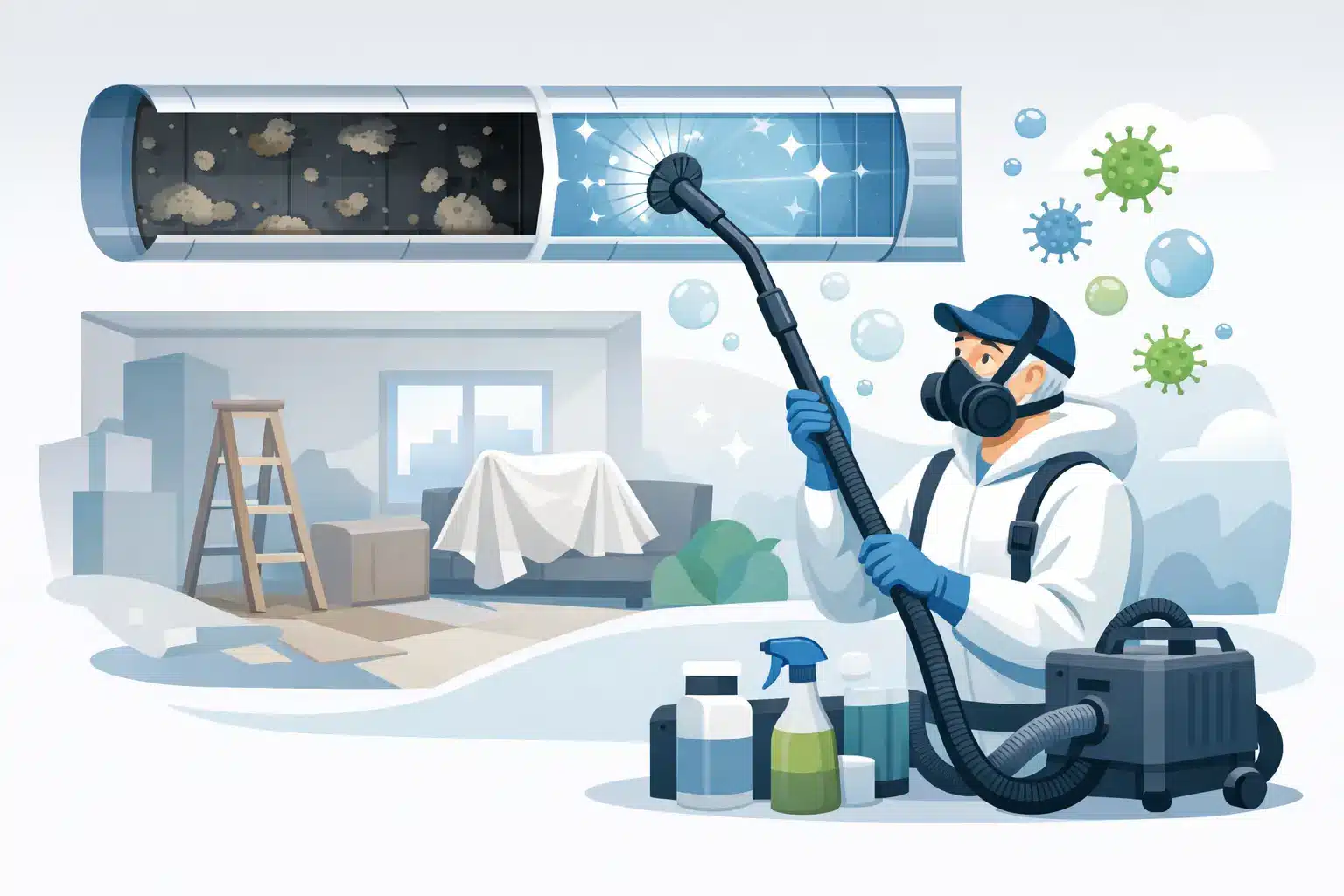
Completed construction work doesn’t always mean the air is healthy again. In this example of duct disinfection after renovation, the home may look spotless at first glance, but the ventilation system continues to circulate fine plaster dust and a construction-site smell. This is a common situation after wall sanding, flooring replacement, partition demolition, or kitchen and bathroom renovations.
Renovation dust is particularly volatile. It can enter return air vents, settle inside ducts, and reach the fan and other ventilation system components. Restarting the system without a proper inspection and cleaning can redistribute these particles throughout every room. For families, allergy sufferers, property managers, and commercial space occupants, this risk calls for a methodical response.
Why Ducts Are Exposed During Renovation Work
Even when a contractor covers rooms with tarps, fine materials travel easily. Gypsum, wood, cement, paint residue, insulation fibers, and sanding dust all move through the air as work progresses. If vents weren’t sealed airtight, or if the system ran during the renovation, some of these contaminants can get pulled in.
The problem isn’t limited to visible dust. Residue can trap moisture and odors, reduce airflow efficiency, and clog filters prematurely. In some cases, pre-existing mold traces, revealed once walls are opened or after water damage, require a more thorough assessment before any disinfection takes place.
Disinfection, then, isn’t simply spraying product into the vents. It has to follow the physical removal of deposits. Without complete dust extraction, disinfectants don’t effectively treat the surfaces involved and can even create a misleading impression of cleanliness.
Example of Duct Disinfection After Renovation: The Case in Question
Take the case of a three-bedroom condo renovated in Montreal. The owners had old flooring removed, some walls sanded, and a new kitchen installed. By the end of the project, they noticed dust settling back on furniture quickly despite repeated cleaning, the furnace filter graying within days, and a dry odor persisting whenever the heating or air conditioning started up.
During the initial inspection, the return air grilles showed visible gray buildup. Inside some ducts, an accumulation of gypsum dust, fine debris, and wood particles was observed. The fan and the accessible compartment of the central unit also needed checking, since contaminants don’t stop at the first section of duct.
The first professional decision is to determine the real scope of the problem. If the dust is limited to a few vents, the intervention can be targeted. If it’s present in the main ducts and return air vents, professional air duct cleaning is preferable. This distinction avoids both insufficient work and unnecessarily broad interventions.
The Professional Procedure, Step by Step
The intervention begins with protecting the space. Technicians secure work areas, limit dust dispersion, and access system components in a controlled way. Vents, return air grilles, and accessible sections are inspected to identify buildup, unusual odors, or signs of moisture.
Next, the network is placed under negative pressure using appropriate extraction equipment. The difference between household maintenance and professional duct cleaning methods is significant when contamination has reached deeper sections of the network.
Supply vents, return air vents, main ducts, and accessible portions of the unit are treated according to the system’s configuration. Filters generally need replacing after the work, even if they still appear usable. A saturated filter reduces airflow and can put some of the captured dust back into circulation.
Disinfection happens after mechanical cleaning. A product suited to ventilation systems is applied in a controlled way to the surfaces that need it. The choice of product, its dosage, and its application method must respect the system’s materials and the observed conditions. A lingering odor doesn’t automatically call for full disinfection: if it comes from a new material, paint, or adhesive still curing, ventilation and humidity control may be more appropriate.
Cleaning or Disinfection: Which Service Is Needed?
After a renovation, full duct cleaning is often the priority. Construction dust is a particulate contaminant: it needs to be extracted, not simply neutralized. Disinfection becomes useful when there’s a specific reason for it; for example, moisture-related contamination, a persistent organic odor, confirmed mold presence, or an incident affecting the network.
This distinction protects the client. A reputable company doesn’t recommend systematic disinfection without a diagnosis. On the other hand, ignoring signs of moisture or biological contamination can leave an active problem in the system. The right service is the one that matches the actual condition of the ducts, the renovation history, and the health of the occupants.
When mold is suspected, the moisture source also needs to be found and corrected. Disinfecting a duct without fixing a leak, excess condensation, or faulty drainage won’t produce a lasting result. The same principle applies to dust: if the work isn’t finished, or if vents remain open during the final stages of sanding, buildup can start again immediately.
Expected Results After the Intervention
In this case, the owners first noticed a clear reduction in dust resettling surfaces. Starting the heating system no longer stirred up visible particles near the vents, and the construction smell faded as new materials finished curing. Replacing the filter also helped the system maintain steadier airflow.
That said, it’s worth staying realistic. Duct cleaning doesn’t replace final site cleanup, wall washing, baseboard vacuuming, or dusting textiles. Carpets, mattresses, upholstered furniture, and curtains can also trap fine particles. When a renovation produces a lot of dust, a comprehensive post-renovation cleaning approach generally gives the best result.
The main benefit is starting fresh from a clean baseline. Occupants reduce recirculation of construction residue, protect mechanical components, and improve comfort throughout the home. For a rental building or commercial space, this also helps deliver a healthier, more professional space to new occupants.
Signs That Call for a Quick Check
After renovation work, certain signs are worth checking without too much delay: dust that keeps reappearing, visibly dirty vents, a filter that clogs very quickly, an unusual odor when the system starts up, or more noticeable irritation symptoms among sensitive occupants.
Extra attention is recommended if the project involved major demolition, water damage, work in the attic or basement, or extended use of sanding tools. In older buildings, the possible presence of hazardous materials must be handled according to applicable rules before duct cleaning proceeds. Contaminants at risk should never be disturbed or vacuumed without a suitable protocol.
Preventing Buildup During Your Next Renovation
Prevention starts before the first hammer swing. Ventilation vents should be sealed airtight whenever the system isn’t meant to run. If heating, air conditioning, or an air exchanger needs to stay in service, protective coverings and filters should be checked regularly. At the end of dusty work, it’s wise to replace the filter and schedule an inspection before running the system at full capacity.
Since 1995, Nettoyage Impérial has supported homeowners, property managers, and businesses in Montreal, Laval, the North Shore, and the South Shore with methods suited to the actual condition of their installations. A professional assessment helps determine whether targeted cleaning, full cleaning, or disinfection justified by observed conditions is the right choice.
After renovation, the best approach is not to rely on how the rooms look alone. A well-timed duct check lets you fully enjoy your renovated space, with a clean ventilation system and more pleasant air to breathe.
How do I know if my ducts have dust from a renovation?
Signs include dust that keeps resettling on surfaces, visibly dirty vents, a filter that clogs quickly, or a dry odor when the heating or AC starts.
Is duct cleaning necessary after every renovation?
Not always to the same degree — the scope depends on how much dust entered the system and whether it reached the main ducts or just a few vents.
What's the difference between duct cleaning and duct disinfection?
Cleaning physically removes dust and debris; disinfection treats surfaces for moisture-related contamination, odors, or confirmed mold, and should follow cleaning, not replace it.
Should I replace my furnace filter after renovation?
Yes, filters generally need replacing after dusty work, even if they still look usable, since a saturated filter can recirculate captured dust.
Can renovation dust cause mold in ductwork?
Not directly, but dust can trap moisture, and if humidity or water damage was also present, it can create conditions for mold, which requires addressing the moisture source as well.
Key Takeaways
- Renovation dust, gypsum, wood, cement, paint residue, insulation fibers, easily enters ducts even when rooms are covered during work.
- Dust buildup reduces airflow efficiency, clogs filters early, and can trap moisture and odors inside the system.
- A proper intervention removes dust physically (negative pressure extraction, brushing/agitation) before any disinfection is applied.
- Disinfection is warranted for specific reasons; moisture contamination, persistent odors, confirmed mold not as an automatic step after every renovation.
- Duct cleaning complements, but doesn’t replace, full post-renovation cleaning of walls, baseboards, carpets, and upholstery.